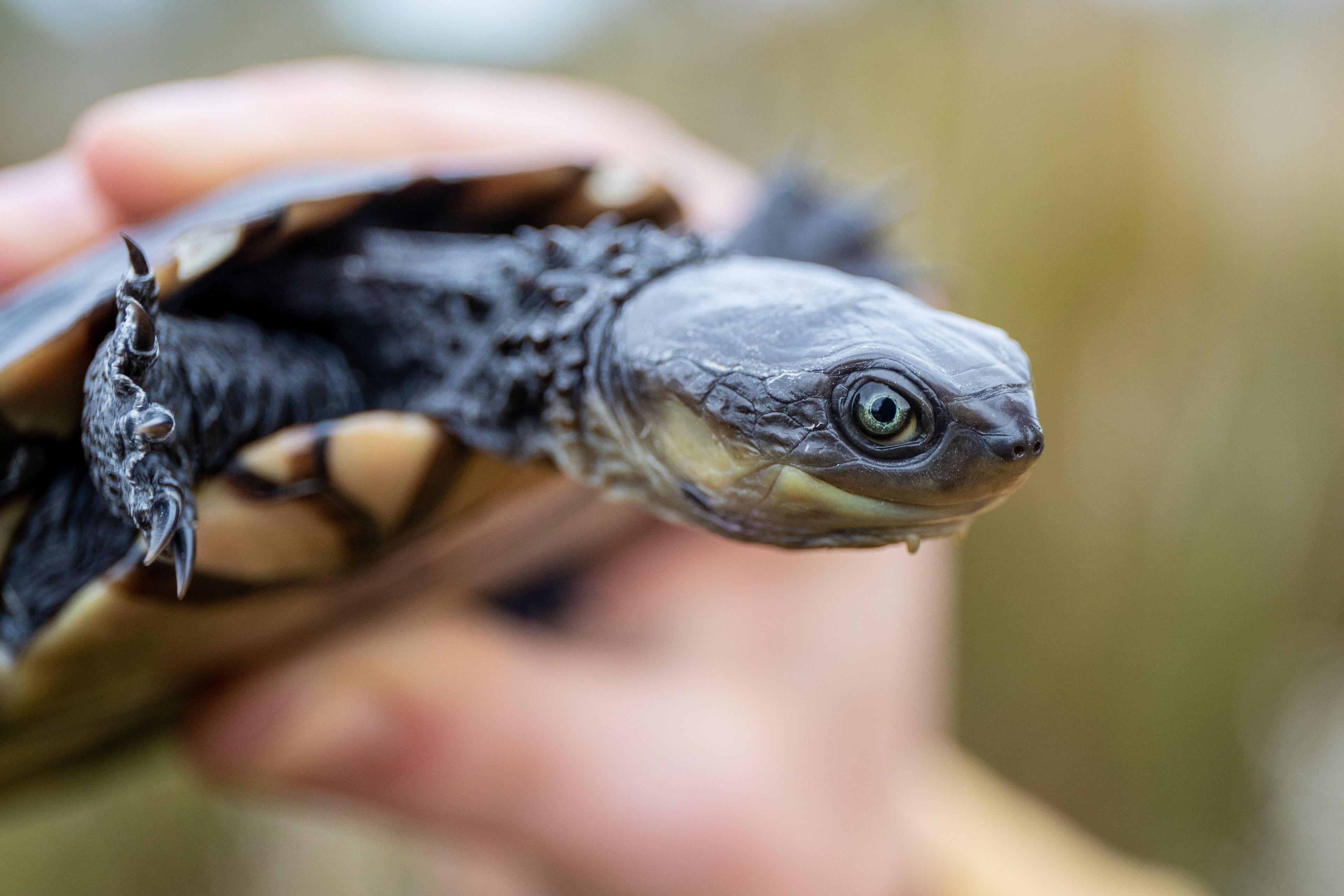
The Critically Endangered Western swamp tortoise. Source: Nicolas Rakotopare
Submission to the Draft Western Swamp Tortoise Environmental Protection Policy 2026
Submission
10 August 2026

Introduction
The Biodiversity Council welcomes the opportunity to provide feedback on the draft Environmental Protection (Western Swamp Tortoise Habitat) Policy 2026 (‘the draft EPP’).
Our understanding
The Western Swamp Tortoise
The Western Swamp Tortoise (or Turtle) is Critically Endangered under the Commonwealth Environment Protection and Biodiversity Conservation Act 1999 and the Western Australian Biodiversity Conservation Act 2016. Notably, it is an EDGE species (Evolutionarily Distinct and Globally Endangered), being the only surviving member of the subfamily Pseudemydurinae, and considered to be the most evolutionarily irreplaceable turtle or tortoise on Earth.
The species was rediscovered in 1953 and, in 1962, two nature reserves - Ellen Brook and Twin Swamps - were created to protect remnant populations north of Perth. By 1985, the population at Twin Swamps was nearly extinct. The first EPP (gazetted in 2003) was developed to protect the habitat at Ellen Brook as it was the only viable wild population.
The Ellen Brook population has been monitored for six decades, revealing the species is slow maturing and very long lived. Recent analysis of population trend data found that relative to fox control, nest protection, captive breeding and translocation, the conservation action that most clearly benefited the adult wild breeding population was increasing the area and quality of protected habitat at Ellen Brook through land acquisition and restoration. This finding makes protection of suitable habitat through the Environmental Protection (Western Swamp Tortoise Habitat) Policy central to the species’ conservation.
The review
A draft EPP has been released in 2026 following a review of the Environmental Protection (Western Swamp Tortoise Habitat) Policy 2011 (‘the 2011 EPP’) by the Western Australian Environmental Protection Authority (EPA) in accordance with section 36 of the Environmental Protection Act 1986 (EP Act).
The review identified several key changes that were required to better protect habitat and manage pressures on the tortoise and its habitat. The changes included:
- Strengthening recognition and protection of habitat in the EPP area.
- More explicit consideration of hydrological regimes.
- Better aligning with the latest scientific research and the 2010 Western Swamp Tortoise Recovery Plan.
- Strengthening requirements for decision makers to consider the potential impacts of development.
- Revising the list of beneficial uses and including ecosystem health conditions to provide more guidance for decision-making and enforcement.
- Updating the area to which the policy applies (the policy area map).
The draft EPP
The draft EPP applies to the Twin Swamps Nature Reserve and Ellen Brook Nature Reserve and the neighbouring properties shown on the policy area map. Surveys between 2023 and 2024 detected fewer than 100 juvenile and adult tortoises in the policy area - 70 at Ellen Brook Nature Reserve and 21 at Twin Swamps Nature Reserve.
The draft EPP’s stated purpose is to protect habitat critical to the long-term survival of the western swamp tortoise in the wild. There are three main objectives in the draft EPP to protect the tortoise’s habitat in the policy area:
- ensuring compatible land use and management
- maintaining and improving hydrology and water quality
- avoiding and minimising detrimental activities, including those that lead to chemical pollution, sedimentation and run-off, altering water flows and lighting fires.
The main mechanism that the draft EPP uses to achieve these objectives is by requiring decision-makers, including those making planning or water management decisions, to have regard to the draft EPP and liaise with the WA Environmental Protection Authority (EPA).
Our key concerns are listed below. Please read the full submission for more detail.
- ‘Minimising’ detrimental activities is inadequate protection
- The policy area does not reflect the tortoise’s reliance on habitat outside reserves
- Hydrology obligations rely on discretionary wording rather than enforceable standards