The damage caused to nature by Australia’s biggest 200 companies
Media Release
27 May 2026
The Biodiversity Council has released a report on the nature impacts generated by Australia’s 200 largest publicly listed companies (the ASX200).
The report identifies the industries and individual companies with the most harmful impacts on nature through water use, greenhouse gas emissions, land clearing, and pollution.
It found that, when considering the direct impacts of company operations, companies in the utilities, materials, energy, industrials and consumer staples sectors have the largest impacts on nature.
It identifies the big miners Rio Tinto and BHP, energy giant AGL, and Alcoa, South32, Fortescue, Newmont, Origin Energy, Mineral Resources, Sandfire, Qantas, Santos, and Woodside as creating significant harm to nature through their water use, greenhouse gas emissions, land clearing, and pollution.
The analysis highlights that some ASX200 corporations, such as Coles, appear to have a lower impact at first glance, but may have a bigger impact than even mining giants, once total supply chain impacts are considered.
Climate risk reporting is mandatory for large Australian corporations. There is a growing global push to also require nature risk reporting due to accelerating biodiversity loss and its threats to health, food production, climate resilience and economies.
Around half of the Australian economy is highly dependent on nature, including industries such as fisheries and nature-based tourism.
The new report is the first to identify which individual Australian companies are likely to come under close scrutiny if mandatory nature risk reporting is introduced.
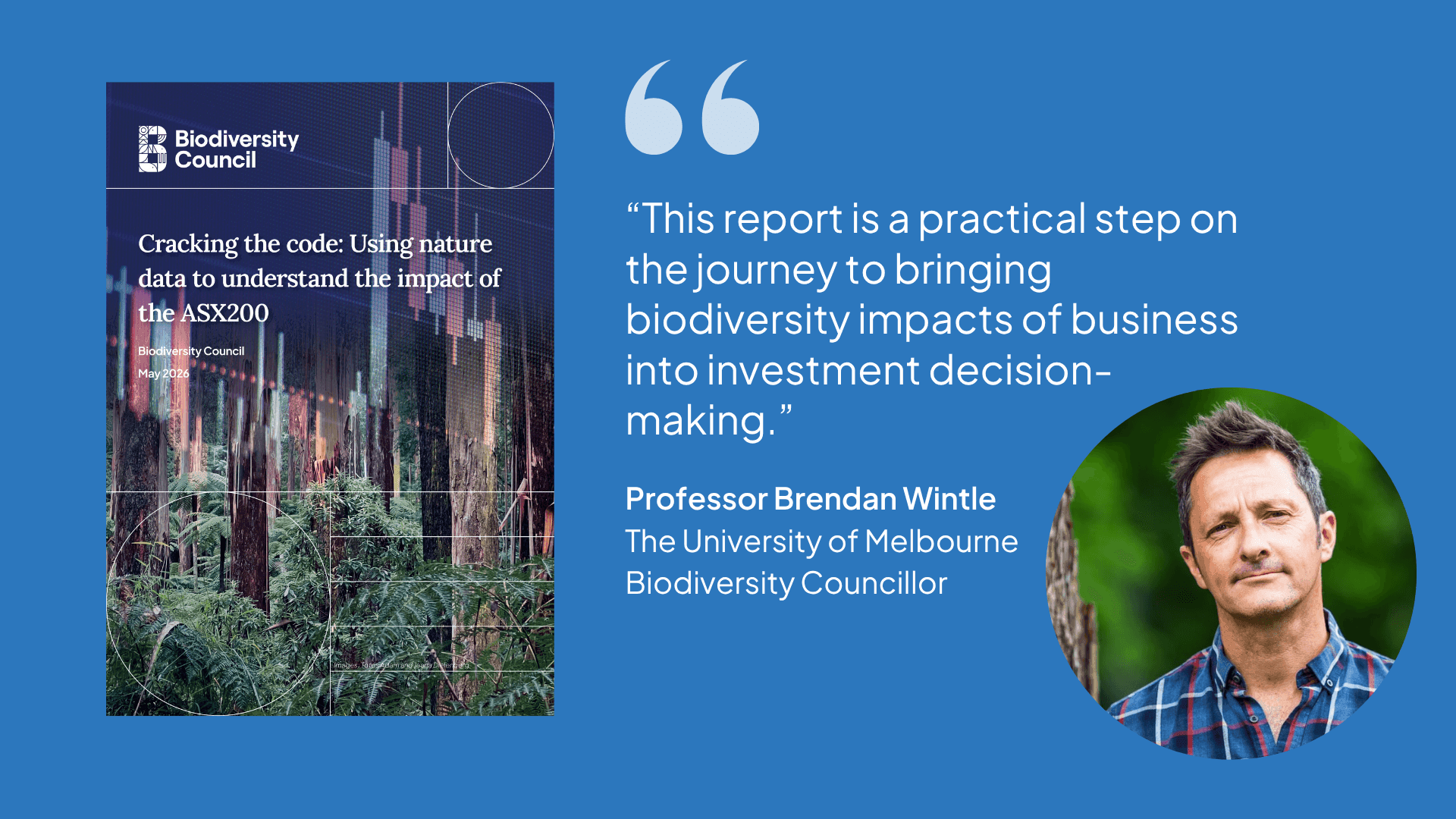
The report, Cracking the code: Using nature data to understand the impact of the ASX200, was launched at the responsible investment conference (the RIAA Conference) at the Melbourne Convention Centre yesterday.
Lead author and Biodiversity Councillor Professor Brendan Wintle of the University of Melbourne said, “Savvy, forward-looking investors are already starting to look at nature impacts, due to the long-term risk it presents to companies.
"Globally, and particularly in Australia, the pace of biodiversity loss and ecosystem degradation is accelerating.
"Nature loss presents material risks for companies and investors, including supply chain disruption, rising operating costs, regulatory and legal exposure, and reputational risk.
"Businesses and investors need to take the financial risks associated with nature loss very seriously.
"This report is a practical step on the journey to bringing biodiversity impacts of business into investment decision-making."