Webinar: 2026-27 Federal Budget Breakdown - what's in it for nature?
Source: Stefan Andrews, courtesy of Great Southern Reef Foundation
Government investment in nature conservation is essential to halt and reverse biodiversity loss and safeguard our economy and livelihoods.
Despite this, Australia has consistently underinvested in the protection and recovery of nature, relative to other wealthy nations.
In this webinar, experts unpack the funding allocated to nature conservation in the 2026-27 federal budget, including which nature-focused programs are winners and losers, and take a detailed look at Indigenous programs and marine spending.
We also cover why governments should stop looking to the private sector to meet conservation funding shortfalls.
Our webinar speakers and topics:
- Lis Ashby, Policy and Innovation Lead at the Biodiversity Council. Topic: Biodiversity Council budget analysis - federal spending on nature conservation.
- Patrick O’Leary, Founding Director of Country Needs People. Topic: Deepdive - funding for Indigenous-led management of Country.
- Alexia Wellbelove, Campaigns Director at the Australian Marine Conservation Society. Topic: Deepdive - funding for marine conservation programs.
- Dr Sophus zu Ermgassen, Nature Finance Lead at Oxford University’s Nature-positive Hub. Topic: Biodiversity finance - sorting fact from fiction.
- Your MC is Prof Sarah Bekessy, Lead Councillor at Biodiversity Council and Professor of Urban Ecology and Biodiversity at the University of Melbourne.
Q&A
How much funding is there for nature in the latest federal budget?
Overall, this budget continues the chronic underfunding of nature in Australia. Our analysis has found the proportion allocated to on-ground nature programs has remained at 0.06% of the budget, or just $1 for nature out of every $1,667.
The total commitment for the 2026-27 year is $496M, compared to an actual spend of $518M in the 2025-26 year. Accounting for inflation, in real terms this is a 9% reduction.
The amount committed declines further in future years, falling to $323M in 2028-29. After allowing for inflation, this is an almost halving (-46%) of on-ground biodiversity investment, reducing nature's share to less than 0.04% of the federal budget.
How much does the Australian Government need to spend to recover biodiversity?
Scientists have calculated that Australian Government investment in nature needs to be lifted to 1% of the budget to meet commitments to prevent further extinctions of native plants and animals. That includes $2 billion per year to save terrestrial species and around $340 million per year to save marine species.
However, to achieve the 23 Kunming-Montreal Global Biodiversity Framework (GBF) Targets agreed to by Australia and 195 other countries in 2022, there must be even more uplift in investment from governments, especially considering the failure to achieve the previous 20 Aichi Biodiversity Targets in the last decade.
An upcoming study, currently under peer review, reveals that governments must spend around $28.5 billion per year from 2025 to 2050 to deliver on the GBF, which is about 1.2% of Australia's GDP, or just over 3% of the current budget.
Is this a big ask? The World Economic Forum estimates that more than half of global GDP is moderately or highly dependent on nature and its services. One could argue it's more like 100%, as you cannot have a society and an economy without a healthy and functioning environment. So, when we say the cost is around 1.2% of Australia's GDP, that's 1.2% to secure the natural systems that the other 98.8% of our economy depends on.
Why was there a substantial underspend in the Saving Native Species program in previous years?
The original announcement for the Saving Native Species fund (SNSF) was $225M over 4 years, ending in 2025-26. However, the full budget was not spent, falling short by just under $60M (see below figure).
The underspend is likely due to relatively short lead times for expenditure and historic deskilling / destaffing of the federal public service and state agencies. Overall, government agency capacity has declined in some of these spaces because of staff cuts, constant shifting of priorities, etc.
This is exacerbated by short periods of funding - it was reported that many on-ground conservation groups had started to wind down programs funded by the SNSF because there was no certainty that there would be funding beyond 2025-26, resulting in loss of staff, skill and momentum. The latest round of funding continues this pattern, with only 2 years of funding announced.
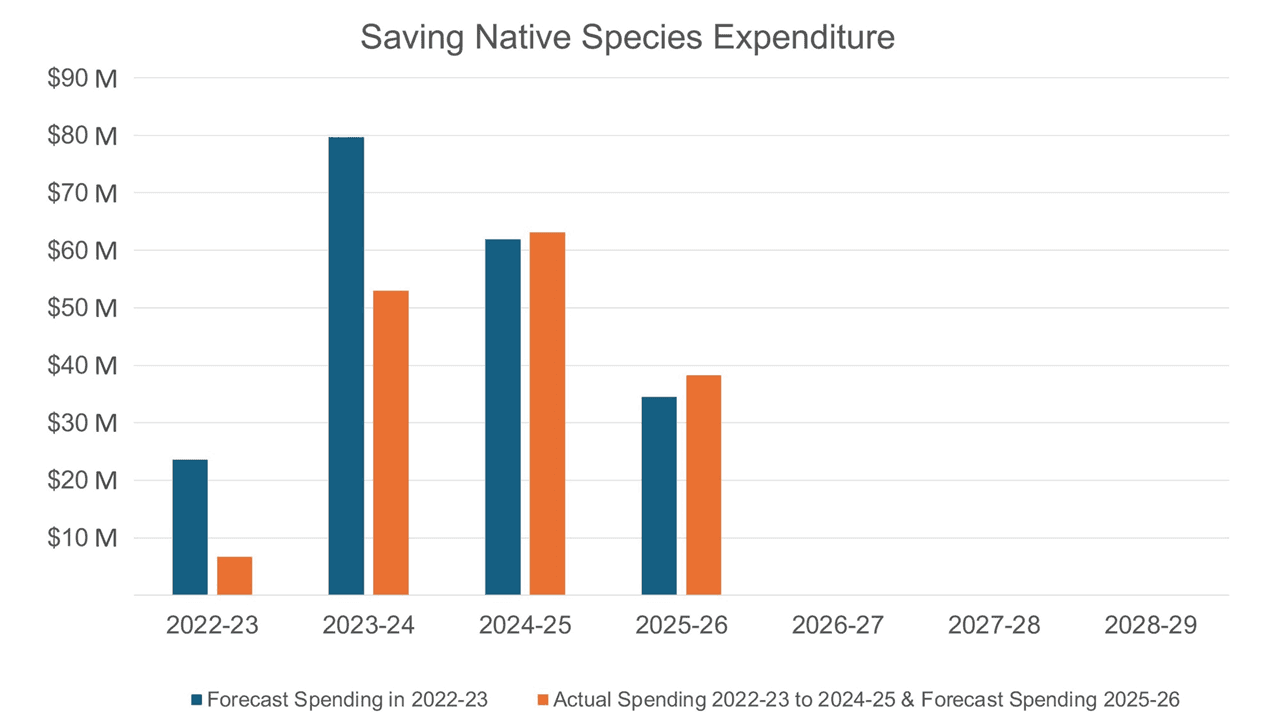
Forecast and actual spending on the Saving Native Species Program.
Why is it that the majority of Aussies want increased spending on nature, yet the Government’s environmental spending is reducing?
According to our survey of community attitudes towards nature conservation, most Australians (76%) believe the Federal Government is already spending at least 1% on nature conservation, with 43% assuming they spend over 2%.
However, when informed that the current budget allocation for nature is less than 1%, nearly all survey participants (95%) believe that spending should be increased.
This shows that, despite there being an appetite for increased funding for nature, a lot of work needs to be done to raise public awareness and drive political pressure. This includes raising awareness of the consequences of underfunding nature so that it’s treated as essential national infrastructure rather than an optional extra.
Why should governments stop looking to the private sector to meet conservation funding shortfalls?
From food production to water security, economies depend on healthy ecosystems, but public and private global finance still overwhelmingly flows towards activities that erode them.
There is now growing international pressure to both reduce environmentally harmful investments and to find new ways to financially incentivise nature recovery.
However, businesses and philanthropists cannot be relied upon to address significant funding shortfalls, because economics and experience demonstrate that, in the absence of government intervention, too little is done to conserve nature.
In short:
- Philanthropy will not fill the gap because in Australia, philanthropic contributions to biodiversity conservation are minimal (less than 1%) compared with the level of investment made by philanthropists in the United States.
- There is a lack of intrinsic demand to purchase biodiversity as an investment product outside of meeting regulatory obligations. Investors and financial institutions have limited incentives to acquire biodiversity credits, as they are not recognized as risk-reducing instruments and do not generate cash flows. For a recent example, see the failure of private investment in Scottish biodiversity.
- Biodiversity offsets purchased to compensate for biodiversity loss do not create additional resources for biodiversity and they often fail. Biodiversity offsets will at best result in neutral outcomes for biodiversity; more realistically they result in overall decline as they fail to compensate for biodiversity loss.
- While carbon credit schemes can deliver co-benefits for biodiversity, they are unlikely to address species extinctions. A recent analysis found that projects under the Australian Carbon Credit Unit Scheme are not delivering habitat restoration for threatened species, as areas most cost-effective for carbon abatement do not align with regions of highest biodiversity need.
Is there spending in the 2026-27 federal budget that has adverse impacts on biodiversity that should be reviewed?
The Biodiversity Council has released a first pass analysis of subsidies in the 2022-23 federal budget for activities that are driving environmental decline. It is a very involved analysis so unfortunately we haven't repeated it for this year’s budget.
That analysis found subsidies that are likely to have a medium to high adverse impact on biodiversity amounted to $26.3 billion. This is 50 times larger than the biodiversity on-ground spend.
The Biodiversity Council is calling for the Australian Government to request the Productivity Commission to undertake an independent assessment of these subsidies. Our study can be used to prioritise subsidy areas that require more detailed consideration.
What sort of ramifications exist for not meeting the international commitments to biodiversity under the Kunming-Montreal Global Biodiversity Framework (GBF)?
The ramifications for failing to meet the GBF targets are largely political and, unless embedded into national laws and policies, are largely not enforceable (though there’s a case for inaction violating international environmental and human rights laws). This was one of the major failings of the 20 Aichi Targets (2010-2020), the precursor to the GBF targets - none of which were achieved in full.
However, several mechanisms could help raise the political cost of inaction:
- First, robust and mandatory public reporting: if governments were required to transparently report annually on both harmful subsidies and GBF funding commitments, in a form comparable to how climate targets are reported, public and parliamentary scrutiny would increase. The GBF itself requires national biodiversity finance reporting; strengthening domestic implementation of this obligation would be a valuable step.
- Second, independent audit: requiring a dedicated independent body, such as the Australian National Audit Office, to assess progress against GBF funding commitments would bring a level of credibility and external pressure that self-reporting cannot.
- Third, strengthening the role of civil society: organisations like the Biodiversity Council can play an important accountability function by independently quantifying Australia’s performance.
None of these mechanisms is a magic bullet, but together they can shift the political calculus by making inaction more visible and more costly to defend publicly.
How much would it cost to achieve the 30 by 30 target?
Forthcoming research from Australian National University researcher Paul Elton suggests about $15 billion per annum over 2025 to 2050 across terrestrial, inland water and coastal and marine ecosystems, to meet the 30 by 30 target (Target 3) at ecosystem scales, including proper funding for the conservation management of extant and new protected areas. Existing funding in this area is likely to be less than $2.5 billion per annum, mainly by states and territories.
Additionally, about another $6.7 billion per annum over the same period is needed for the related GBF Target 2, to effectively restore 30% of degraded ecosystems.
Is it more effective to campaign for an overall increase to environment funding or campaign for individual program areas?
This depends on your organisational strategy. Many organisations campaign for funds for specific actions or programs - the amounts are usually more modest. Success can mean a genuine benefit in a specific area.
But just focusing on funding one action here or there can mask the much bigger issue of lack of funding overall, and the government sometimes meets one of those specific asks by pulling funding out of another equally important program. We are not really winning if the amount of money for biodiversity is going down, even if it is being shuffled between buckets.
The Biodiversity Council is trying for an ambitious step change in funding, lifting it from 0.06% to 1% of the federal budget.
Both approaches can be done at the same time by different organisations, rather than everyone just needing to choose one.