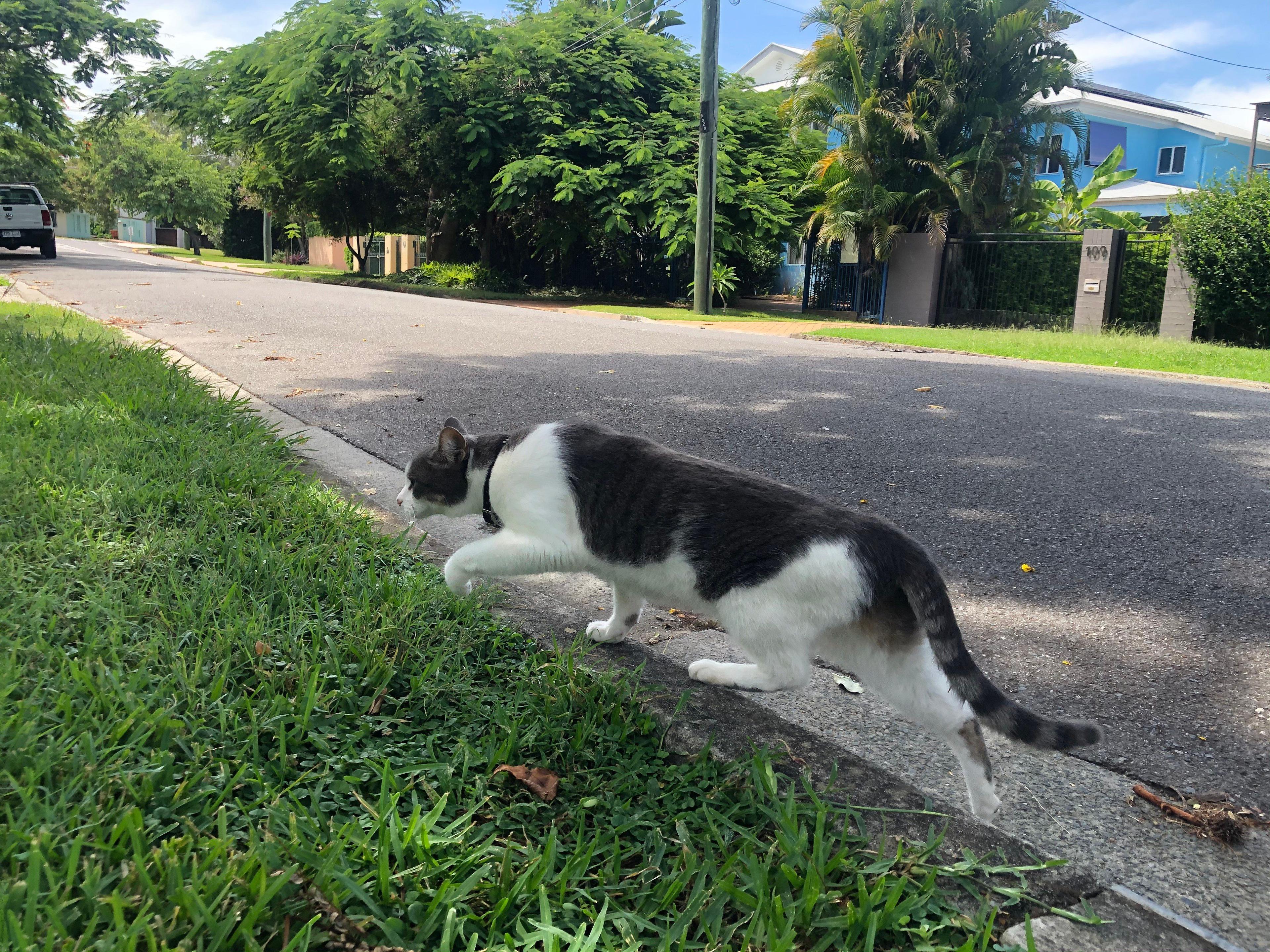
Source: Jaana Dielenberg
Denialism doesn’t change the reality that roaming pet cats are a scourge for Australia’s wildlife
3 September 2026
Australia's unique wildlife is under unprecedented threat, with introduced predators like cats playing a significant role in driving native species towards extinction. Despite the overwhelming scientific consensus on the detrimental impacts of roaming pet and feral cats, narratives that downplay these threats now risk further harm to Australia's biodiversity.
The context
Australia has the worst record of mammal extinctions of any country in modern times: 40 species have been driven extinct since European colonisation, and many more species are declining and threatened with extinction.
Scientists, Traditional Custodians and conservation managers have worked over many years to understand what has caused these losses, which species are still at risk, and how we can stop further declines. A very large and compelling body of evidence has shown that introduced predators – cats and foxes – are the major cause, often exacerbated by other threats.
The impacts of cats and foxes are not limited to mammals: research has shown that they also prey on native birds, reptiles, frogs and invertebrates, with an annual toll exceeding 3 billion animals. They also spread pathogens that cause diseases in wildlife, livestock, and people, including toxoplasmosis, which is cat-dependent, and would not exist in Australia if cats were absent.
Apart from some islands that these introduced predators did not reach, or island and fenced havens from which they have since been eradicated, there is no part of Australia that does not have cats, foxes, or both.
Cats have the larger distribution: they live in the tropics, alpine areas, rainforests, woodlands and deserts. They live not only in the bush, but also around towns and cities, as strays, and as free-roaming pets. Regardless of where they live and their lifestyle, cats kill native animals. On average, an individual pet cat kills at one quarter of the rate of individual feral cats. However, there are over 5 million pet cats in Australia, more than twice the population of feral and stray cats, and those pet cats are concentrated at high densities in populated areas, so their total predation pressure in these areas is higher than for feral cats in the bush.
Cat owners are often unaware of their pet’s habits. Most cat kills are not brought home, and pet cats can wander a long way, often risking their lives crossing busy roads and encountering dangerous animals. The ‘landscape of fear’ that they create changes the behaviour and stress of their prey.
Feral cats are notoriously challenging to control, but conservation managers have made extraordinary progress in the last 10-20 years at reducing feral cat (and fox) impacts through intensive efforts around populations of threatened species, especially mammals. Reducing the impacts from pet cats is technically and conceptually much easier: pet cats should be desexed at an early age to prevent unwanted breeding, and they should be prevented from roaming – by being kept indoors, in an enclosed outdoor area, or by being walked on a leash – to stop them maiming and killing other animals. Such containment should not be contentious: controlling the breeding and movements of domestic animals are basic tenets of responsible ownership for any pet, and should also be so for the local governments that oversee pet and pest management.
The efforts of scientists and conservation managers to understand and then reduce cat impacts has been supported by policy at all levels of government. The Commonwealth Government released a revised national threat abatement plan in 2024, and coordinates actions across the jurisdictions via the National Feral Cat Taskforce. Some states and territories have revised, or are revising, their domestic animal legislation to strengthen cat management. Many local governments, who are responsible for delivering domestic animal management on the ground, are following suit. Across Australia, communities are increasingly demanding such change from decision makers.
The progress sounds promising for wildlife and pet cats; what’s the problem?
Against this backdrop, it is extremely disappointing to witness the campaign of a small group of researchers whose published work and related advocacy consistently reaches conclusions at odds with the broader body of evidence on cat impacts and management. In Australia, the researchers are mostly affiliated with the Australian Pet Welfare Foundation (APWF) and the University of Queensland (UQ). They advocate for the interests of pet and stray cats, apparently at the expense of other considerations. For example, they argue against euthanasia for stray cats and they do not support mandatory pet cat containment, contrary to evidence that roaming cats kill wildlife, spread disease, annoy neighbours, and can experience poor health and welfare.
In our view, the campaign follows a recurring pattern in which science is claimed as justification for media messaging that extends beyond what the underlying data support, and casts unfounded doubt on the research findings reported by others. We are concerned that this pattern risks eroding public confidence in the very large body of evidence regarding the impacts of cats, and how best to manage them, as well as science more broadly.
The first step in this pattern is to publish an article relating to roaming pet and/or stray cats, usually in one journal devoted mainly to animal welfare. Although other researchers may then demonstrate the shortcomings of these articles, such as questionable methods, interpretations that over-reach the data presented, and inaccurate characterisations of other research, the original articles are cited as the ‘scientific proof’ for statements in press releases that seem unsubstantiated by the primary research. These press releases turn into media, and the public are exposed to messages that claim to be evidence-based. However, selective interpretation and messaging can sow confusion in the public, and can undermine policy and legislative reform, to the detriment of us all.
The most recent example of this pattern occurred in July 2026. The group published a paper in the journal Animals, reporting statistics on what animals were brought into NSW wildlife rehabilitation centres over 11 years, and what their injuries were attributed to. Vehicle strike, unsuitable environment, abandoned/orphaned, fell from tree/nest, and entanglement were the most common reasons for such animal rescue and rehabilitation. The incidence of cat, fox, and dog attacks as the cause of animals brought into care was low. The authors framed the title and main messaging of the paper to convey that pet cats are not a threat to wildlife after all, and we need to focus on other threats instead.
These data tell us something about what animals are brought into care. They tell us nothing at all about cat impacts on wildlife. Cats hunt small animals out of sight of their owner. The chance that a captured small animal is not eaten, that it survives the cat attack, that it is seen by the cat owner, and is taken to a rehabilitation centre, is infinitesimally small. This point is reinforced by the near-absence of fox attacks in the rehabilitation data. Foxes drive native species declines in Australia, and they are present in the suburbs of Australian cities. However, they are near-absent in the rescue data for the same reasons that cat attacks are low: the attacks happen outside the awareness of people, are usually fatal, and the evidence is eaten. In another example for why animal rescue data cannot be used to understand cat impacts: two species (koala and grey-headed flying-fox) dominate the records of threatened species (82%). Cat predation is not a major cause of injury and ill health in these two species, so using these records as evidence that cats do not affect threatened species is perplexing.
Wildlife shelter data tell you only what injured animals people find and then think practical and worthy of the effort of taking to a shelter. Studies have shown that many animals known to be preyed on by cats, including reptiles and rodents, are feared and disliked by many in the community, greatly reducing the likelihood that they would take them to a shelter if found injured. The strong bias in what is taken to shelters is a point well illustrated by what animals were taken to wildlife triage centres set up in Victoria after the Black Summer bushfires by DELWP and Zoos Victoria: 75% of the animals taken to triage centres were koalas; only small numbers of other species were taken in. No one would use these data to argue that the fires did not impact other types of animals, as it would be a ridiculous false equivalence. The mischaracterisation of the NSW wildlife shelter data as being representative of the main threats to wildlife is a similar false equivalence, but can be harder for the broader community to spot in media reporting.
The authors themselves admit the limitations of the data in the body of their paper: "Rehabilitation data should not be used to estimate total wildlife deaths in highly modified environments, the true number of animals affected by each cause, or the overall ecological importance of different threats."
And yet, the author’s framing that pet cats are not a threat to wildlife became the focal point in a UQ press release about the paper, and then found its way into mainstream media. ABC News published a story on 16 July 2026 with this headline: “Pet cat impact on wildlife could be overstated, UQ researchers say”. The ABC article says that new research is challenging the evidence about the impacts of roaming pet cats on Australian wildlife. The messaging now proliferates through social media put out by cat focused groups.
On its journey, the story picks up additional, hitchhiking inaccuracies that can undermine confidence in the existing evidence base on cat impacts. For example, the ABC news story includes a quote from the lead researcher claiming that pet cats have been unfairly blamed because “we have been using data obtained from our feral cats on our urban cats”. This is demonstrably false. Over many different studies in Australia and worldwide, scientists have laboriously recorded the kills brought home by pet cats, examined the poo of pet cats to record what they have eaten, and they have fitted small kittycams to neck collars so the hunts made by pet cats can be witnessed.
The research group’s misleading interpretations about their own research on the impacts and management of both pet and stray cats, and their mischaracterisations about prior research, are regularly refuted by polite commentary in the scientific literature, such as here, here, and here. But meanwhile, the damage to public understanding of the issues is harder to redress.
Such selective messaging in campaigns has real-world consequences. Boroondara Council voted In July 2026 on a motion to introduce cat containment bylaws. A recent survey of local community views showed that most Boroondara residents support stronger cat management, including containment. And yet, a report by council staff argued against cat containment. The APWF/UQ study, and other research published by that group, was used as supporting evidence in that council report. The report had some traction, contra the evidence base for pet cat impacts and contra the community views. The Council resolved to adopt partial rather than full containment, and to advocate for changes to state legislation to allow stray cats to be desexed and then left on the streets to roam. This would be a regressive change. Last year, APWF-associated publications were used by the Animal Justice Party to suggest key messages that the public could include in submissions into the NSW inquiry into the Management of Cat Populations in NSW. Partly as a result of this advocacy, the inquiry did not recommend mandatory containment of pet cats, against the advice from conservation experts and to the dismay of Local Government NSW.
Advocacy campaigns founded on selective and unsubstantiated messages shouldn't outweigh the volumes of research from Australia and overseas that tell us, with high levels of certainty, that while pet cats can be cherished pets, if they are allowed to roam they:
- Kill native wildlife, and cause harm and suffering to many, many individual animals
- Cause population declines in wildlife
- Spread cat-dependent diseases that impact native animals, livestock and humans
- Are a nuisance to neighbours and the wider community
- Experience higher rates of injury and sickness and live shorter lives than contained cats
All policy positions are based on ethical commitments, not just evidence. There is scope for mature ethical discussions about the importance of various conflicting values, including biodiversity, the interests of pet cats, and any other values at stake such as the convenience of people. But undermining a clear scientific consensus around biodiversity impacts can appear as an attempt to mislead readers and risks further eroding the public’s imperiled trust in science. The national conversation about cats should be clear about values that conflict and which values are being prioritised in any policy position, but should not involve attempts to cast doubt on the validity of the evidence base that has been compiled through rigorous scientific investigation.
Please see the statement for the full list of signatories, including 98 individuals and 34 organisations and societies.