Open Letter: Intergenerational Equity demands greater investment in the protection and care of nature
Submission
2 June 2026
Dear Prime Minister and Ministers,
Open Letter: Intergenerational Equity demands greater investment in the protection and care of nature
We write as scientists, Indigenous Knowledge Holders, conservation experts and young people to express our deep concern at a further reduction in federal investment in on-ground biodiversity conservation in the 2026-27 Budget. We request that the government adopt long-term investment in the care of nature, lifting investment in on-ground biodiversity conservation to at least 1% of the budget.
Intergenerational equity
The Government has rightly emphasised intergenerational equity in housing and economic opportunity for younger Australians. But intergenerational policy does not stop at the right to equitable access to housing – true intergenerational policy must consider all aspects of our lives, including a healthy environment.
The Australian Government already understood this 50 years ago; our national environmental law, the Environmental Protection and Biodiversity Conservation Act 1999, explicitly includes ‘the principle of inter-generational equity - that the present generation should ensure that the health, diversity and productivity of the environment is maintained or enhanced for the benefit of future generations.’
Australia’s natural environment is in decline
Our environment is essential to all Australians, from the lands and oceans that sustain us, to the air we breathe, the food produced by healthy oceans, soils and pollinators, the boost it gives to our health and the emotional connections we build with each other and the world around us. It defines our national identity and the way others around the world see us.
Australia’s environment is officially assessed as poor and deteriorating. Continued biodiversity decline creates growing economic, environmental and social costs that will ultimately be borne by future generations.
We urge the Government to adopt long-term biodiversity investment that matches the growing scale of the challenge and Australia’s commitments, including sustained funding for threatened and declining species and ecosystems, Indigenous land and sea management, restoration, protected areas and environmental monitoring.
Australians want action to protect nature
Benchmark surveys conducted by Monash University for the Biodiversity Council found that 96% of Australians believe more action is needed to protect the natural environment, with 58% saying ‘a lot more’ or ‘a great deal more’ action is required. The surveys also found that 95% of Australians believe more of the federal budget should be dedicated to nature protection, and most people (76%) thought it should be at least 1% of the budget.
Furthermore, Australia has committed internationally to halt and reverse biodiversity loss this decade under the Kunming–Montreal Global Biodiversity Framework. This includes a commitment to prevent extinctions, conserve 30% of land and oceans by 2030, restore ecosystems, and better manage biodiversity threats.
A budget that will fail nature
Current levels of investment remain grossly inadequate to achieve these commitments or to meet community expectations that Australia will protect its unique flora, wildlife and ecosystems. We are greatly disappointed by both the inadequate scale and short-term nature of biodiversity funding in the budget. Many conservation programs receive only one or two years of funding despite ecological recovery operating over decades. Short funding cycles undermine workforce capability, partnerships with communities and Traditional Custodians, program effectiveness, and long-term planning.
Compared to actual expenditure in 2025-26, investment in on-ground biodiversity conservation on land and in our oceans will decline by around 9% in 2026-27 in this budget in real terms once inflation is taken into account. By 2028-29, on-ground investment in nature will almost halve in real terms.
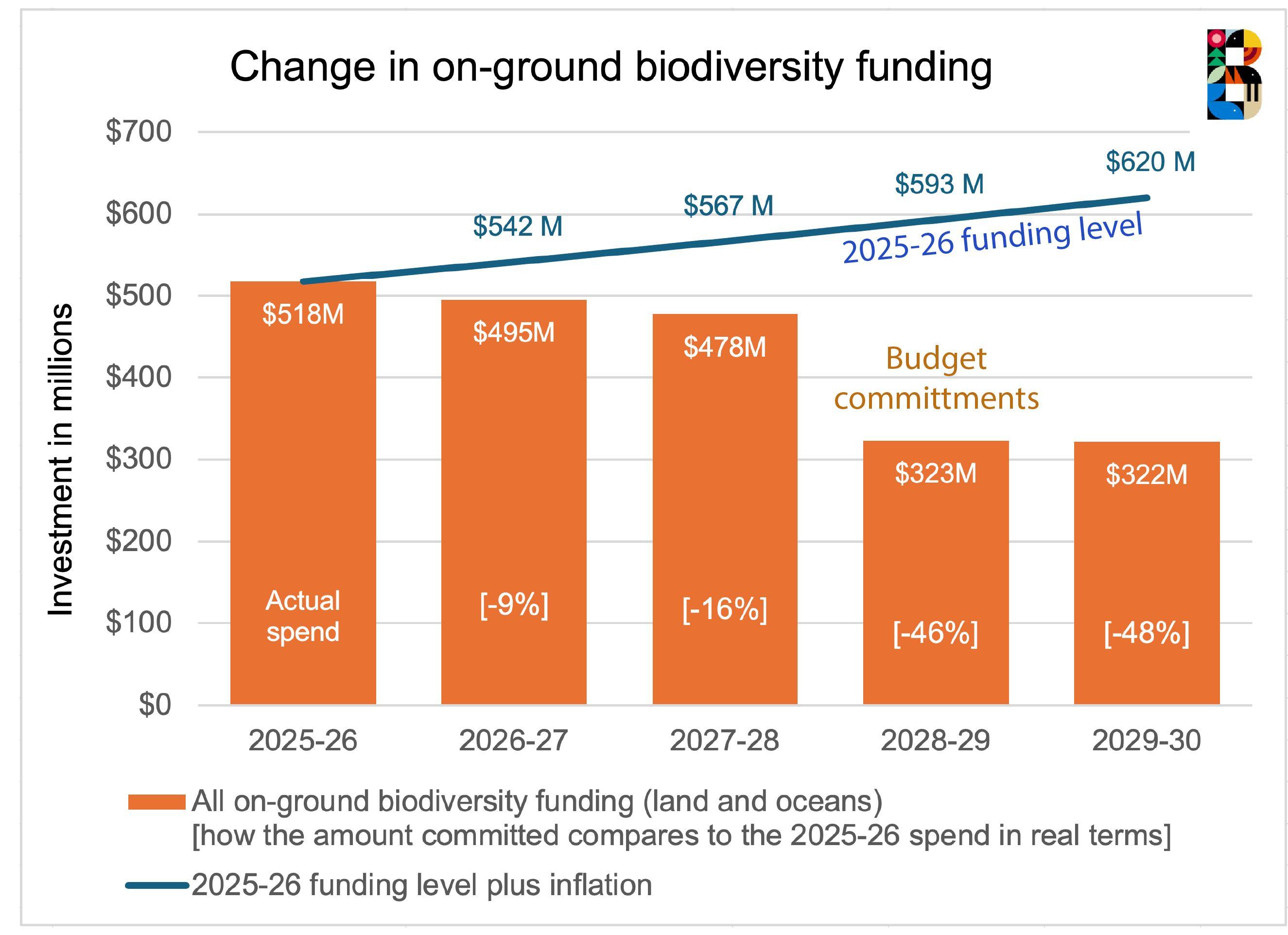
Australian Government total actual spend on on-ground biodiversity programs (land, freshwater and marine) in 2025-26, and budget commitment in future years. The dark blue line shows 2025-26 funding level plus the inflation rate. The percent in [brackets] is the change in funding compared to 2025-26 in real terms. Source: Prepared by the Biodiversity Council based on data in Australian Government budget papers.
At the same time, substantial funding has been allocated to environmental regulatory reforms that appear primarily focused on accelerating development approvals rather than improving outcomes for matters of national environmental significance, including threatened species and World Heritage Areas.
We acknowledge and welcome the Government’s investment in on-ground conservation programs for the Great Barrier Reef, funding for the Australian Institute of Marine Science to monitor and research the Reef and other tropical ecosystems, the modest two-year extension to the Saving Native Species Fund and two-year commitment to support recovery efforts for the Maugean Skate, and funding to prepare for the serious impacts of avian influenza. These investments demonstrate the Government recognises the importance of long-term environmental stewardship when sufficient priority is given.
However, Australia’s other ecosystems and more than 2,000 nationally listed threatened species continue to receive grossly inadequate attention and funding. Funding to manage the harm of invasive species has also been cut.
Investment for risk management
Investment in ecosystem monitoring and management is prudent risk management. For example, the Great Southern Reef - a globally significant marine ecosystem supporting thousands of jobs, major fisheries and tourism industries, and around $12 billion annually in economic activity - is facing major pressure from warming oceans yet lacks a coordinated long-term national monitoring and management program.
Investment in nature protection and restoration can also support long-term regional employment through ecosystem restoration, Indigenous land and sea management, environmental monitoring and sustainable tourism as part of Australia’s growing nature-positive economy.
Nature’s value extends well beyond estimates of its financial value. Healthy ecosystems provide clean water, improve human health and wellbeing, social and cultural values, recreation, tourism, and reduce risks of environmental disasters such as harmful floods, fires and algal blooms. These benefits are shared across society and underpin Australia’s longterm prosperity and security.
Australia cannot achieve genuine intergenerational equity while passing on a deteriorating natural environment. We urge the Government to adopt long-term funding and to lift investment in the care of nature to at least 1% of the budget.
Yours sincerely,
Scientists, Indigenous Knowledge Holders, conservation experts and young people
For a full list of signatories, please download the letter.