What’s in the 2026-27 federal budget for nature?
Source: Nicolas Rakotopare
News story
15 May 2026
The 2026-27 federal budget was released on Tuesday 12 May. We have closely examined it to see what it held for nature. Here are some of our insights.
In brief
Overall, this budget continues the chronic underfunding of nature in Australia; funding for nature falls slightly in 2026-27 and more rapidly after that, while investment in speeding up environmental approvals has been supercharged - equivalent to half of all on-ground nature spending.
There has been a small short-term extension for the Saving Native Species Fund. Smaller and more targeted Agricultural Stewardship and Biosecurity programs have been slashed over the next four years.
The lion’s share of investment for both biodiversity research funding and ocean conservation programs are focused on the Great Barrier Reef, with other areas neglected, including ecosystems that are far more economically important. There is budget for a new smaller phase of the National Environmental Science Program.
Nature underpins Australia’s economy and wellbeing, yet the Government is still failing to adequately invest in its recovery.
The total allocation for nature stays low
The increase in funding for on-ground nature-focused programs that scientists and conservation groups have been calling for has not occurred.
The proportion of the federal budget allocated to on-ground nature programs has remained at 0.06% of the budget, or just $1 for nature out of every $1,667.
The total commitment for on-ground nature-focused programs for the 2026-27 year is $496M, compared to an actual spend of $518M in the 2025-26 year. Accounting for inflation, in real terms this is a 9% reduction.
The amount committed declines further in future years, falling to $323M in 2028-29. After allowing for inflation, this is an almost halving (-46%) of on-ground biodiversity investment, reducing nature's share to less than 0.04% of the federal budget.
Scientists have calculated that Australian Government investment in nature needs to be lifted to 1% of the budget to meet commitments to prevent further extinctions of native plants and animals, restore 30% of Australia’s degraded lands, and conserve 30% of Australia’s land and sea areas by 2030.
The largest single source of funding for on-ground biodiversity programs is the Natural Heritage Trust (NHT), accounting for almost half (45%) of all spending ($221M in 2026-27). The budget papers do not enable a program or project level breakdown of the funding in the NHT, but large investments include Indigenous Protected Areas, threatened species and priority landscapes, and urban rivers and catchments. There is a very slight increase in NHT funding in the two years ahead, before falling to $50M (-19%) below the 2025-26 level from 2028-29.
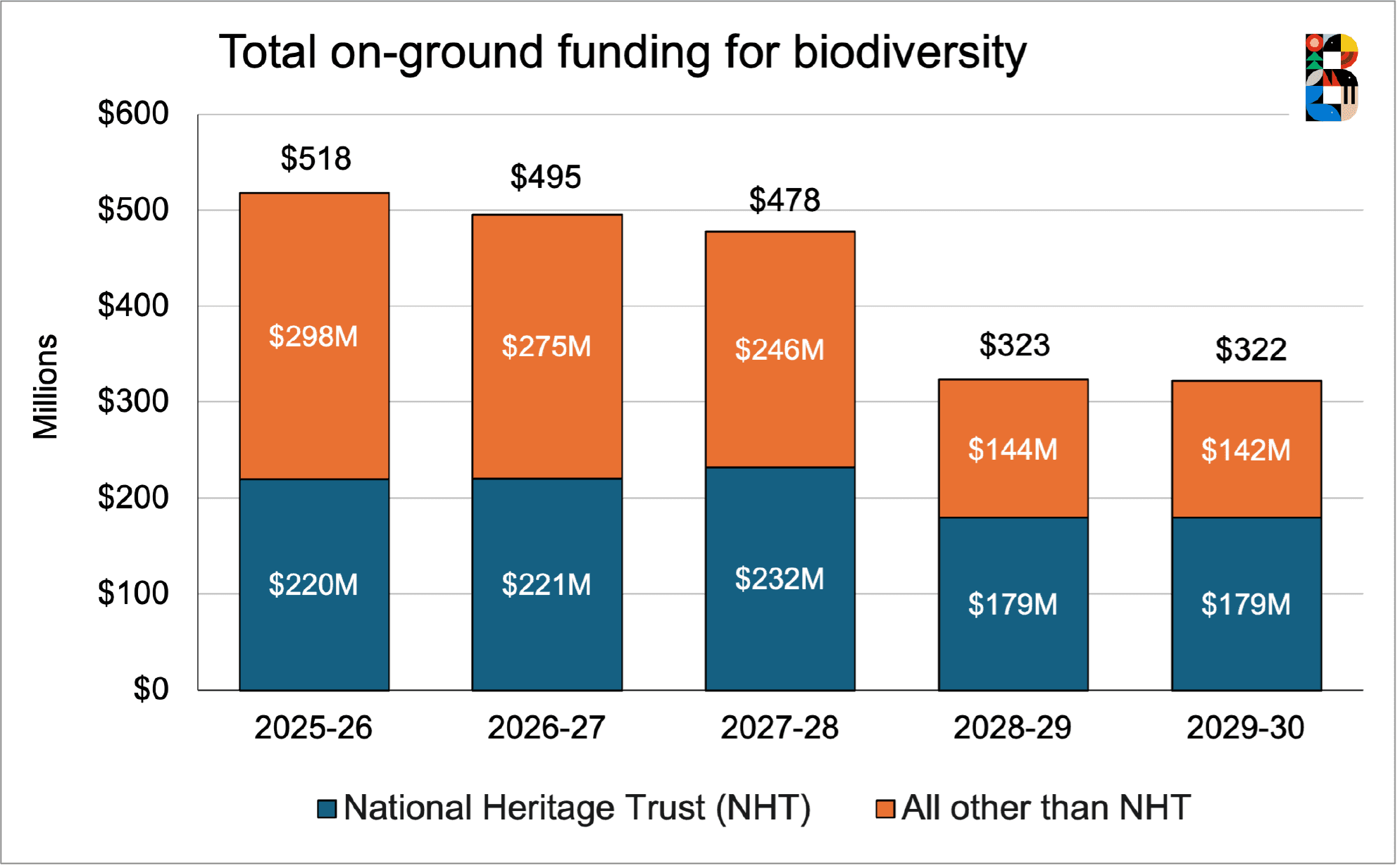
Australian Government total expenditure on on-ground biodiversity programs, including both the National Heritage Trust and all other spending. Source: Prepared by the Biodiversity Council based on data in Australian Government budget papers.
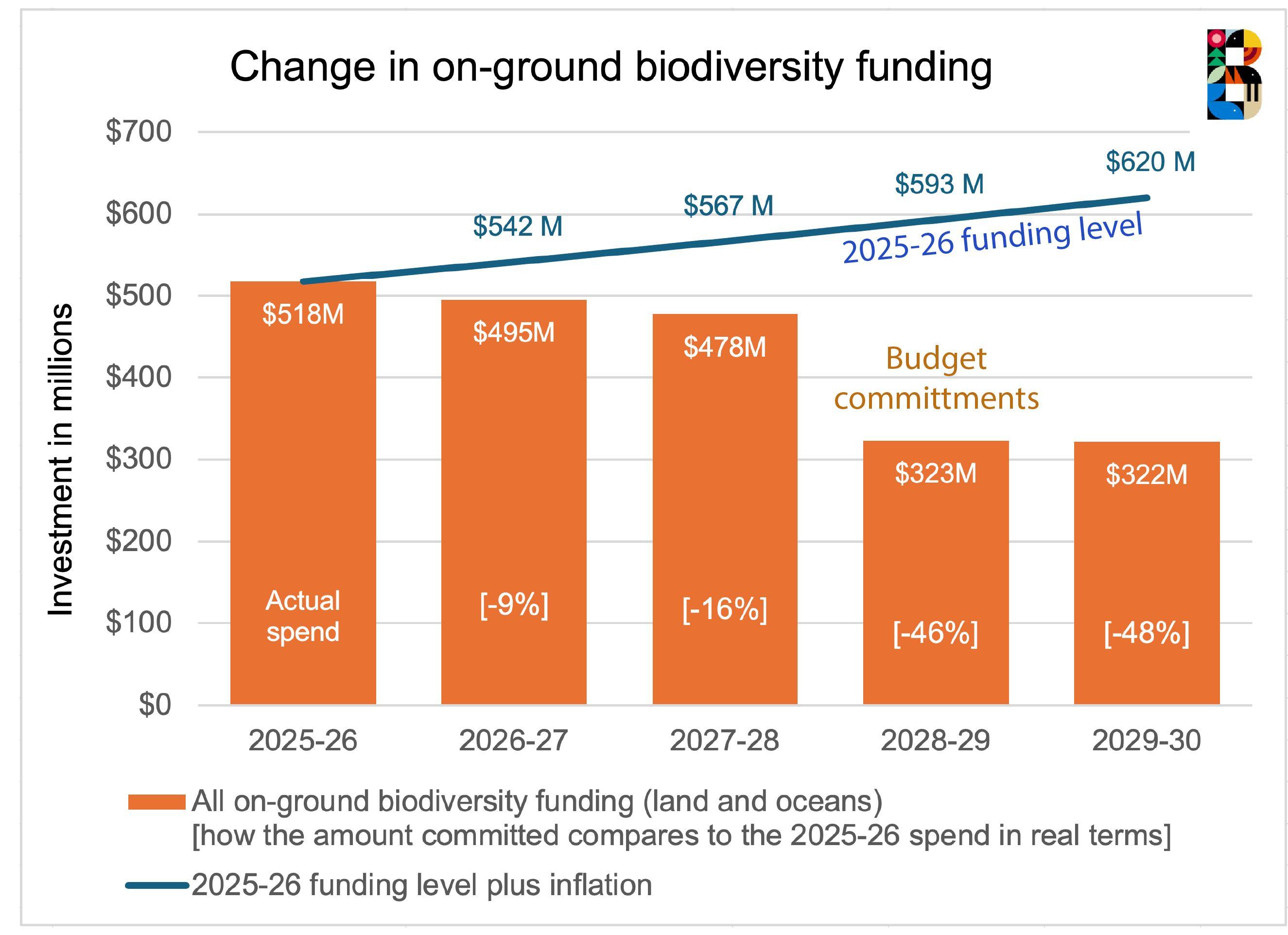
Australian Government total actual spend on on-ground biodiversity programs (land, freshwater and marine) in 2025-26, and budget commitment in future years. The dark green line shows 2025-26 funding level plus the inflation rate. The per cent in [brackets] is the change in funding compared to 2025-26 in real terms. Source: Prepared by the Biodiversity Council based on data in Australian Government budget papers.
Investment to speed up development dwarfs important nature programs
A standout feature of this budget is the huge injection of funding aimed at fast-tracking development and reducing the Australian Government’s involvement in the assessments of projects that trigger the federal Environmental Protection and Biodiversity Conservation Act 1999 (EPBC Act) because they are considered likely to have a significant harmful impact on endangered species, World Heritage Areas and other matters of national environmental significance (MNES).
The Government has committed $215.1M in 2026-27 and $234.6M in 2027-28 to this regulatory reform and streamlining, which is focused on making it easier for developers. They have said this will include the development of AI tools to help developers but have not published how much money is being allocated to this.
For the next two years they have announced $50.1M to help developers find offsets to compensate for their destructive impacts on threatened species and World Heritage Areas. This includes $36.9M for the Clean Energy Regulator to administer the Nature Repair Market and $13.2M for the Restoration Contributions Holder.
They have separately announced $65.6 million over 4 years from 2026-27 to progress the development of bilateral agreements to devolve EPBC Act assessment and approval powers to all states and territories and deliver six regulatory bioregional plans. These figures are not itemised in the budget papers and are not included in the graph below.
The per annum amounts for these activities, which are very likely to speed up harm to the environment, dwarf the funding of the Australian Government's two signature programs tasked with meeting key environmental commitments: the Saving Native Species Fund (preventing extinctions) and Australian Bushland Program (conserving 30% of ecosystems by 2030).
As indicated in the graph below, the investment in regulatory reforms (red) is more than double the combined investment in the Saving Native Species Program (green) and the Australian Bushland Program (yellow).
It is also equal to half of the federal government’s total investment in on-ground land, freshwater and marine conservation programs.
Overall, resources for the Department of Climate Change, Energy, Environment and Water (DCCEEW) are also falling. This includes: an 11% reduction in departmental resourcing, which includes DCCEEW staff salaries and operations; and a 21% reduction in administered spending compared to last financial year, which covers specific programs, grants and benefits.
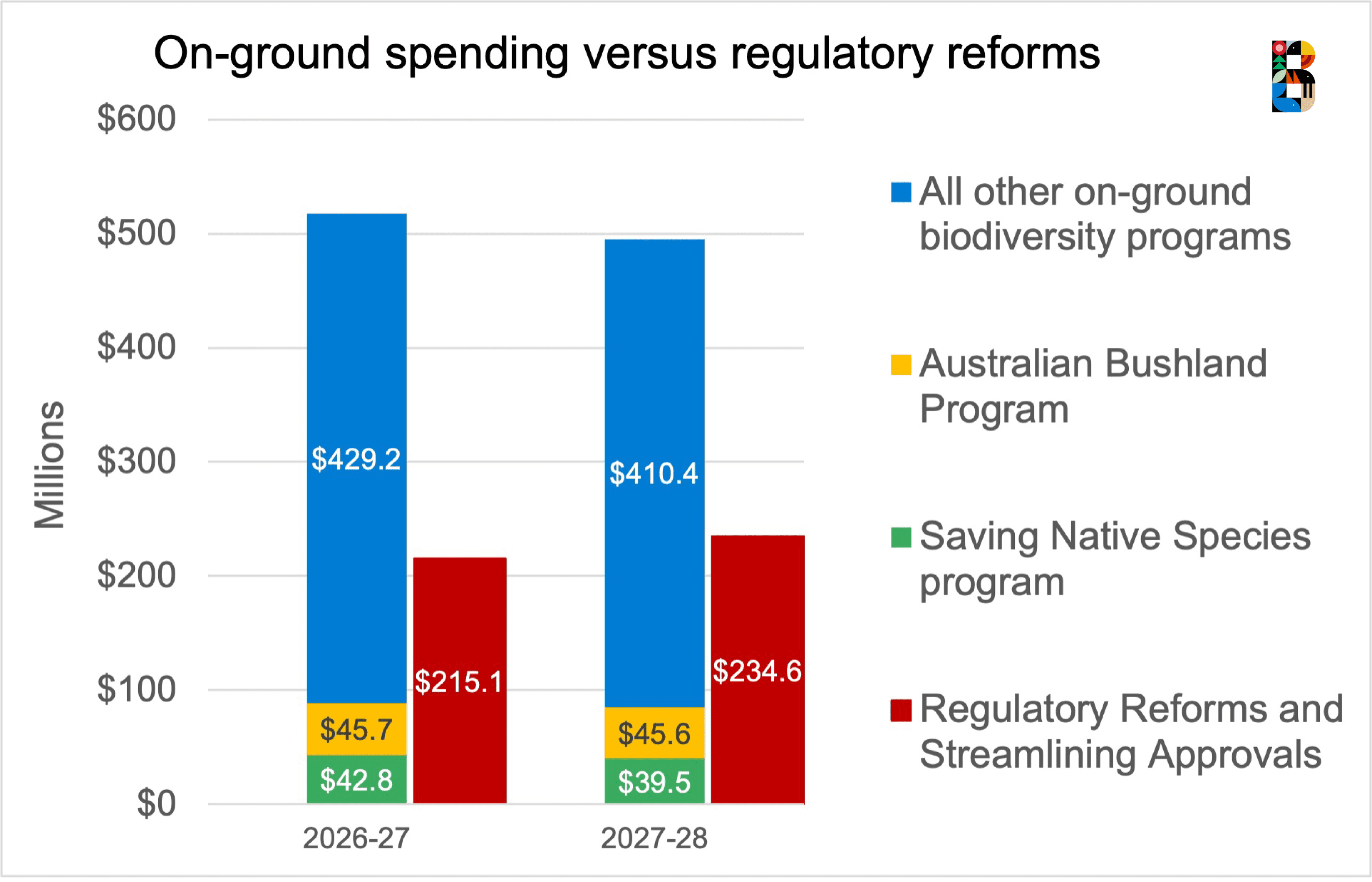
Total expenditure on-ground for biodiversity (left stacked columns) versus expenditure to speed up development by streamlining or devolving environmental assessments (right red columns) by year. Source: Prepared by the Biodiversity Council based on data in Australian Government budget papers.
Diminishing long-term funding for on-ground biodiversity work
Land and freshwater programs
Total funding for land and freshwater-focused on-ground conservation programs won’t significantly change from 2025-26 to 2026-27 ($358.4M down to $355.8M), but commitments decline in future years, dropping to $229.2M from 2028-29.
The largest commitment supporting on-ground biodiversity action is the Natural Heritage Trust (NHT), which accounts for two-thirds or more of all on-ground spending for land and freshwater focused programs. The value of the NHT is $220.6M in 2026-27.
Second largest is the Australian Bushland Program, which was a commitment made in 2025 to invest $250M over five years to establish new conservation areas to meet Australia’s commitment to conserve 30% of all ecosystems by 2030. That funding is still rolling out, with between $47M and $50M per year over the next four years. It is important to note that the total over the 5 years is $237M, $13M less than the original announcement.
The Australian Bushland Program is the primary mechanism used by the federal government to meet a commitment under the Convention on Biological Diversity to conserve 30% of each Australian ecosystem by 2030. It’s estimated that 20 times that amount is needed to deliver the full commitment of a connected and protected area network that represents all key ecosystems.
The original announcement for the Saving Native Species fund (SNSF) was $225M over 4 years, ending in 2025-26. According to the budget papers, it has been extended for 2 years, with $39.5M in 2026-27 and $38.3M in 2027-28.
These amounts are different to the recent announcement claiming the new investment in SNSF is $99.6M over two years. The discrepancy may be accounted for by the federal government counting other programs in the total of the announcement - the details are not transparent.
It is important to note that, despite the shortage of funds for threatened species recovery on the ground, the full budget of the SNSF was not spent in earlier years. If the underspends are carried forward, then it is only $18.8M in new funding across the two years, and there is nothing committed beyond 2027-28. The funding available per year is reduced, with a 9% reduction in funding compared to 2025-26 ($42.8M), and a 37% reduction compared to 2024-25 ($63.1M).
The SNSF is the primary mechanism used by the federal government to meet a commitment under the Convention on Biological Diversity, and to the Australian community, to prevent more extinctions of native plants and animals. This small and short-term amount is inadequate to achieve that commitment. So far, we have only seen the Australian Government prioritise 110 out of Australia’s 2,106 surviving nationally listed threatened species.
The only other on-ground land and freshwater biodiversity programs in the budget are: $9.6M per year for World Heritage sites, but only for two years; and $14.2M in the coming 2026-27 year for H5N1 Avian Influenza Preparedness. The Environmental Stewardship Program, which sought to support threatened ecological communities, has ended.
Over the next two years, $18M per year will also be spent on Local Environmental Projects, some of which may have significant benefits for biodiversity, while others may be driven more by social values, such as increasing amenity or animal welfare.
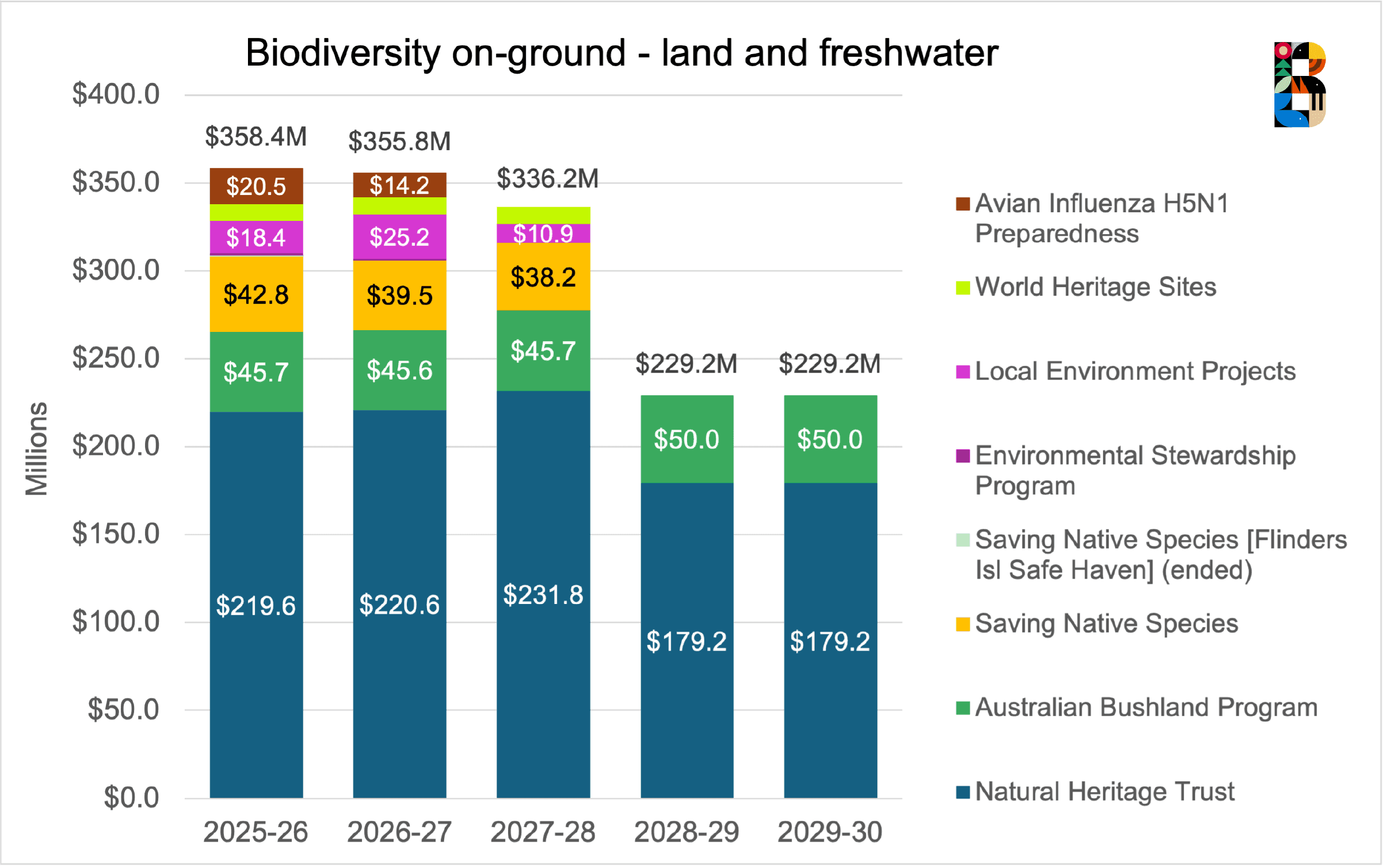
Australian Government investment in on-ground land and freshwater-focused conservation programs. Programs that occurred in 2025-26 with no funding in any future year are marked ‘(ended)’ in the legend. Source: Prepared by the Biodiversity Council based on data in Australian Government budget papers.
Marine programs
The takeaway for oceans is that there is an overall reduction in funding, and there is little investment in anything except the Great Barrier Reef. This is despite the huge ecological, economic and social value of marine ecosystems in other parts of the country.
For example, the Great Southern Reef is globally unique; 70% of Great Southern Reef species occur nowhere else, and it makes a far larger contribution to the economy ($12 billion per year) and to national seafood supply.
The only oceans program with longer-term investment is for Strengthening the Great Barrier Reef through Stewardship and Leadership, with an average budget of $100M per year over the next four years. This is a decrease from earlier years ($119.5M in 2024-25). The Great Barrier Reef focused Reef 2050 Plan also gets $42.1M of new funding over the next 2 years.
Beyond the Great Barrier Reef, there is a total of only $5.6M over the next two years for all other marine parks; and $10M for Sustainable Fisheries in 2026-27 only, and money for the Maugean skate.
Tasmania’s Maugean skate, which is impacted by salmon aquaculture in Macquarie Harbour, is the only threatened species to be singled out for dedicated funding, receiving an average of $5.7M per year but only for the next two years. This is part of a four year funding package announced in an earlier budget.
This is a reasonable annual amount to invest in the conservation of a threatened marine fish species, similar to the amount spent annually per threatened marine fish species in the United States (AUD$5.1M per year per species), where conservation programs have been far more successful. However, Australia has 22 EPBC Act-listed threatened marine fish species in addition to the Maugean skate, and scientists have estimated that $117M per year is needed to recover all of these species.
Programs that will end by 30 June are: Reef Plan 2050: Traditional Owner Implementation Plan; Land and Coastal Restoration; Reef Guardian Councils; and Restore Blue Carbon Ecosystems and NT Marine Parks, which received a total of $32.8M in 2025-26 between them, with two-thirds going to reef focused programs.
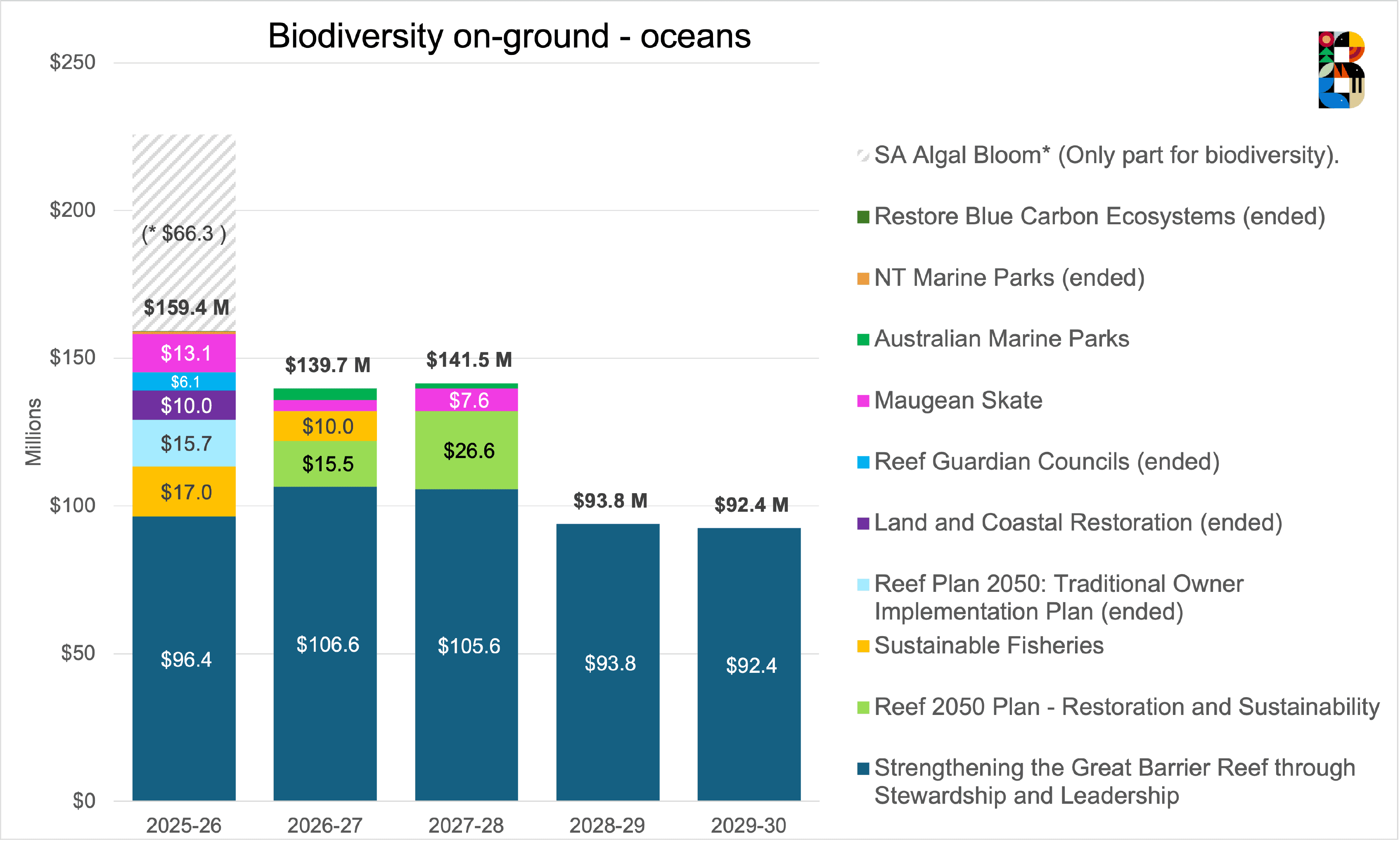
Australian Government investment in marine-focused programs. Programs that occurred in 2025-26 with no funding in any future year are marked ‘(ended)’ in the legend. Source: Prepared by the Biodiversity Council based on data in Australian Government budget papers.
Biodiversity research investment - most going to AIMS
Overall, investment in biodiversity research will fall slightly from $122M in 2025-26 to $110M in 2026-27 and $112M in 2027-28.
It is not just on-ground marine programs that are heavily skewed toward the Great Barrier Reef - Australian Government investment in biodiversity research and monitoring is also scant beyond the Great Barrier Reef.
The vast majority of all federal investment in biodiversity research goes to just one institution, the Australian Institute for Marine Science (AIMS), which researches and monitors tropical marine ecosystems, including the Great Barrier Reef.
AIMS will receive $92.2M in 2026-27, and increase slightly each year with $97.3M committed in 2029-30. It will receive 84% of all federal biodiversity research funding in each of the next four years.
The current phase of the National Environmental Science Program (NESP) will end in 2026-27, and there had not previously been an announcement regarding a subsequent phase. This budget shows $15.8M per year for the NESP from 2027-28 to 2029-30, so it looks like a next phase of the program will occur. However, it will be smaller, as the budget is around one-third less than the current program.
Beyond these two programs, there is $2M per year for the Australian Biological Resources Study, and a final year for the Paddock to Reef Monitoring program, with $2.3M allocated in 2026-27 but nothing further.
The Australian Government is investing in research and monitoring for the Great Barrier Reef and other tropical reefs through AIMS. However, they are not our only important marine ecosystem assets.
One glaring gap is the lack of investment to monitor the Great Southern Reef, despite its $12 billion per year contribution to the national economy. It stretches across five states and is also being impacted by climate change and marine heatwaves, yet lacks a co-ordinated monitoring and research program to guide its sustainable long-term use.
Biodiversity research investment is not included in our total for biodiversity on-ground spending.
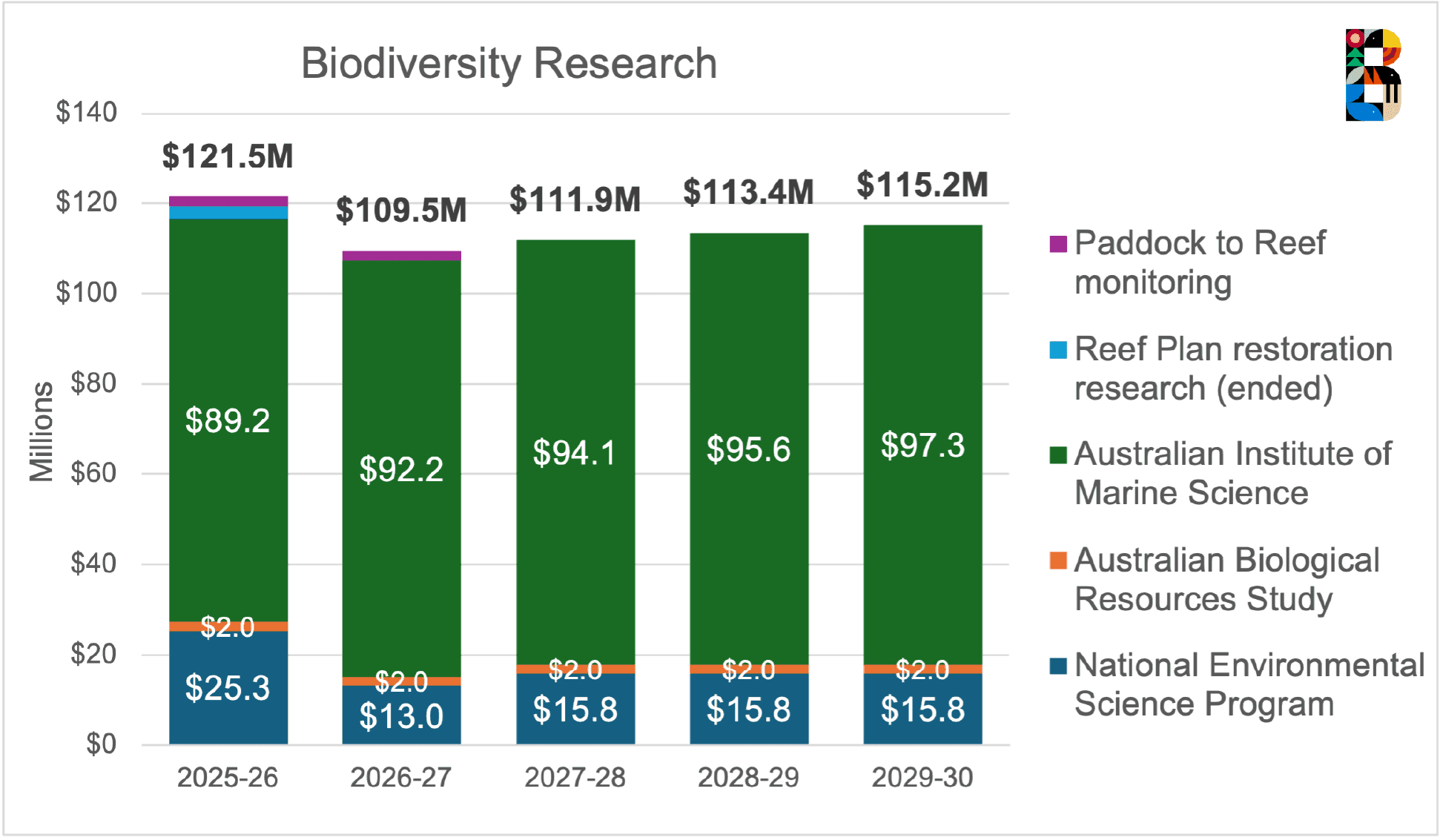
Australian Government funding for biodiversity research. Programs that occurred in 2025-26 with no funding in any future year are marked ‘(ended)’ in the legend. Source: Prepared by the Biodiversity Council based on data in Australian Government budget papers.
Large reductions in agricultural stewardship and biosecurity investment
Budgets for investment in agricultural stewardship and biosecurity programs that benefit nature are rapidly declining over the next four years, and many programs are ending.
More than 80% of all spending in this area goes to Pest and Disease Preparedness and Response, however it is rapidly declining. Compared to the 2025-26 spend, this program will be reduced by one quarter (-26%) in 2026-27, half (-54%) in 2027-28, and by 83% in 2028-29.
The only other programs with longer-term (4 years) funding committed are: Agriculture 2030 Pilot soil stewardship (average $4.6M per year), Indigenous Rangers Biosecurity Program (average $3.5M per year), and Priority Pest and Disease Planning and Response (average $3.1M per year).
The National Plant Health Surveillance Program has three years of funding at $1.3M per year.
Programs with funding ending in two years are the National Soil Action Plan (average $2.9M per year), and Yellow Crazy Ant Control (average $4.5M per year). While the Management of Established Weeds and Pests program will have its final year in 2026-27 ($2.9M).
Many other programs will end this year, including National Carp Control Program, Agriculture 2030 Biosecurity, and Agriculture Stewardship Package. These had a combined total of $7.4M in 2025-26.
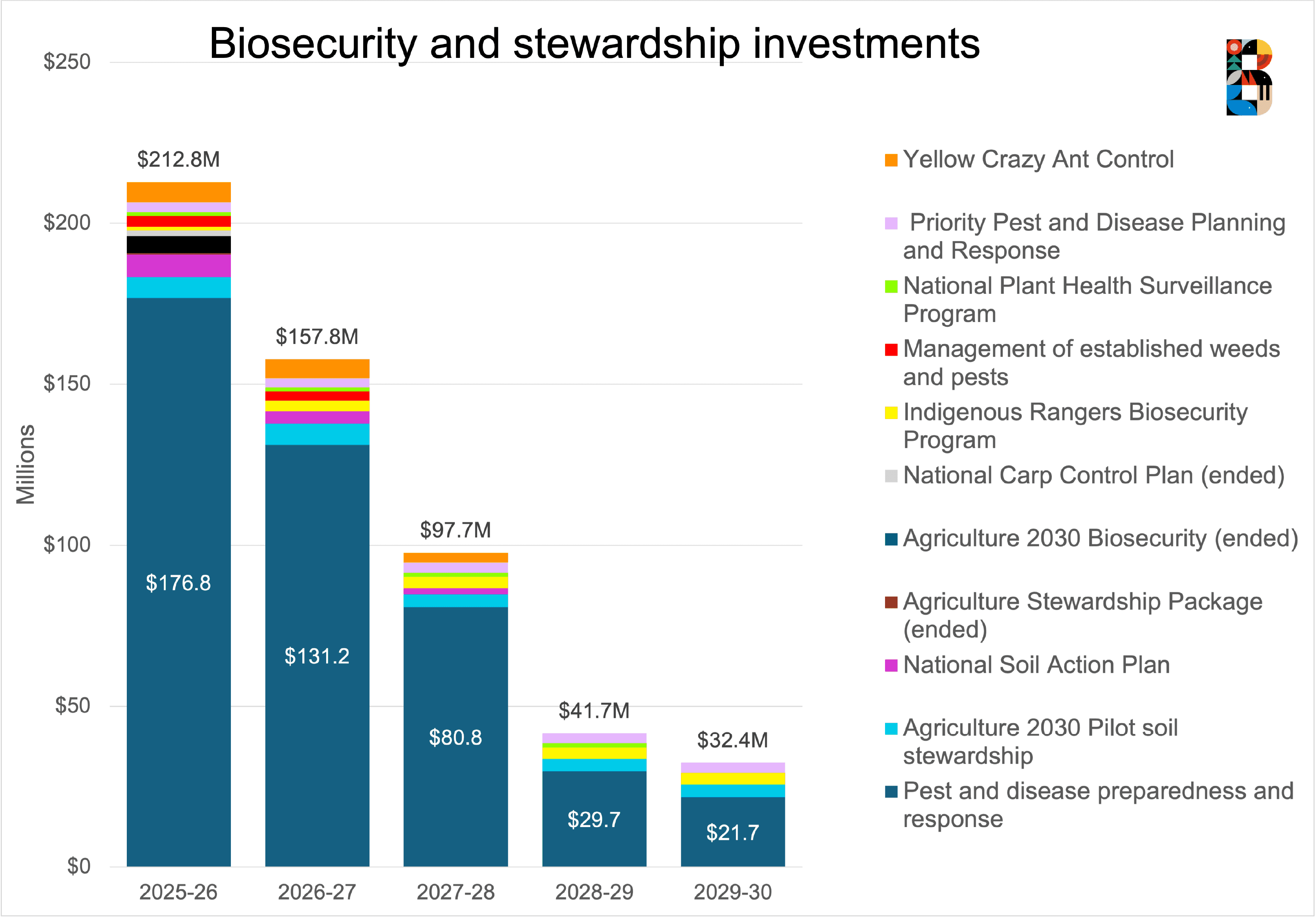
Australian Government funding for biosecurity and stewardship programs. Programs that occurred in 2025-26 with no funding in any future year are marked ‘(ended)’ in the legend. Source: Prepared by the Biodiversity Council based on data in Australian Government budget papers.
Our overall assessment
Overall, this budget continues Australia’s long-term underinvestment in nature.
While there are small short-term funding extensions for key biodiversity programs, they fall well short of what is needed to prevent extinctions, restore ecosystems and meet national environmental commitments. At the same time, the Government is investing heavily in streamlining environmental approvals and devolving powers to states, with a strong focus on process rather than environmental outcomes.
Nature underpins Australia’s economy and wellbeing - continuing to run down our natural assets while failing to adequately invest in their recovery is environmentally and economically short-sighted.
Lifting nature’s share of the federal budget to just 1% would provide enough funding to meet most of the Australian Government’s environmental commitments. Research undertaken by Monash University for the Biodiversity Council found that most Australians believe that at least 1% of the federal budget should be dedicated to nature protection.
Methodology
The Biodiversity Council reviewed the Portfolio Budget Statements of the Department of Climate Change, Energy, Environment and Water (DCCEEW) and the Department of Agriculture, Fisheries and Forestry (DAFF) to identify nature-related programs, Budget Paper 3 to identify national partnership payments for environment energy and water (the Federal government paying State and Territory governments for specific initiatives) and Budget Paper 2 to identify measures for environmental reforms.
The following programs have been categorised as ‘on-ground biodiversity programs’: the Natural Heritage Trust, Australian Bushland Program, Saving Native Species, Saving Native Species (Flinders Island Save Haven), Environmental Stewardship Program, World Heritage Sites, Avian Influenza Preparedness Program, Local Environment Projects, Maugean Skate Conservation and Recovery, Great Barrier Reef Leadership and Stewardship Program, Reef Trust Programs, Australian Marine Parks, Sustainable Fisheries and the Oceans Leadership Programs. Funding for these programs can be found in the 2026-27 DCCEEW Portfolio Budget paper Outcome 2 Program 2.1: Sustainable Management of Natural Resources and the Environment (pp. 57-58) and 2026-27 Budget Paper 3 Federal Financial Relations Environment, Energy and Water National Partnership payments for environment, energy and water (pp.92-111).
The funding for the Director of National Parks is not included in ‘on-ground biodiversity programs’ as expenditure is largely administrative. The most recent Director of National Parks Annual Report (2024-25) shows that approximately 50% of expenditure is on staffing and a further 20% is on professional services, with only 8% spent on National Parks Operational Expenses and grants.
Some programs have been classified as ‘biodiversity adjacent’ because, while they are assumed to deliver some benefits to biodiversity, it is difficult to determine what proportion, given they are often designed to deliver other benefits. We have included the Algal Bloom Support Package as ‘biodiversity adjacent - environment and community benefit’ because it is intended to support social, economic and environmental recovery, and Urban Rivers and Catchments, which would deliver social and environmental benefits. Agricultural stewardship and biosecurity programs have also been reported separately under ‘biodiversity adjacent - agriculture & land stewardship’ and ‘biodiversity adjacent - invasives’ because it is hard to separate biodiversity from agricultural benefits.
The following programs have been categorised as ‘stewardship and biosecurity’: Agriculture 2030 Soil and Stewardship pilot, Agriculture Stewardship Package, Agriculture 2030 Biosecurity: For reduction and prevention activities to reduce the economic and environmental burden of established feral animals, pests and weeds, National Carp Control Plan, Indigenous Rangers Biosecurity Program, Management of established weeds and pests, National Plant Health Surveillance, Enhancing Australia’s Biosecurity System – Priority Pest and Disease Planning and Response, Pest and Disease Preparedness and Response Programs and Yellow Crazy Ant Control. Funding for these programs can be found in 2026-27 DCCEEW Portfolio Budget paper Outcome 2 Program 2.1: Sustainable Management of Natural Resources and the Environment (pp. 57-58), 2026-27 DAFF Portfolio Budget Paper Outcome 1 Program 1.2: Sustainable Management - Natural Resources (p. 29), Outcome 2 Program 2.1: Biosecurity and Export Services (pp. 45-46) and 2026-27 Budget Paper 3 Federal Financial Relations Environment, Energy and Water National Partnership payments for environment, energy and water (pp.92-111).
The following programs have been categorised as ‘biodiversity research’: National Environmental Science Program, Australian Biological Resources Study, Australian Institute of Marine Science, Reef Plan 2050: Research to support landscape restoration and the Paddock to Reef Monitoring, Modelling and Reporting Program. Funding for these programs can be found in the 2026-27 DCCEEW Portfolio Budget paper Outcome 2 Program 2.1: Sustainable Management of Natural Resources and the Environment.
Funding on streamlining approvals and implementing environmental reforms can be found in 2026-27 Budget Paper 2 Payment Measures (summary on pp. 23-24 and detail on pp. 48-49). It should be noted that while budget announcements refer to multi-year funding for the Nature Repair Market, Restorations Contributions Holder and Regional Forest Agreements these programs are not itemised on a year-by-year basis, so only aggregate figures are provided. It should also be noted that while the government has announced multi-year funding for Bilateral Agreements and Bioregional Plans, these are not itemised on a year-by-year basis. They are excluded from the 2026-27 DCCEEW Portfolio Budget paper (see footnote ‘e’ on p. 56) and they are ‘not for publication’ in the 2026-27 Budget Paper 3 Federal Financial Relations Environment, Energy and Water National Partnership payments for environment, energy and water (see tables on p.98).