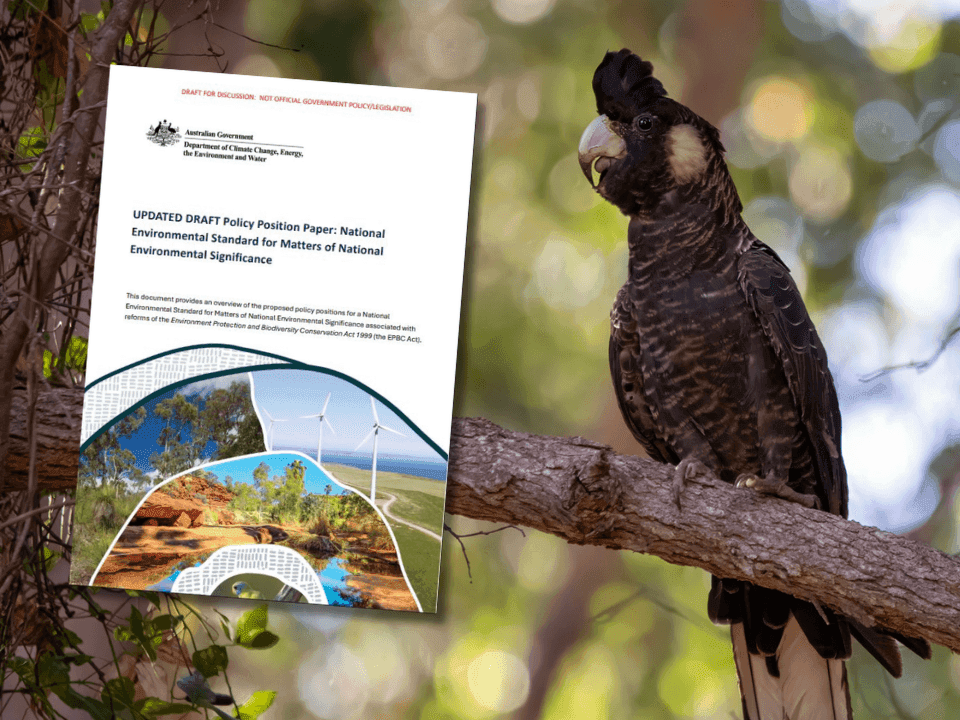
Source: dandm22 / iNaturalist CC BY-NC
Submission to the National Environmental Standard for Matters of National Environmental Significance (MNES)
Submission
27 May 2026
The Biodiversity Council welcomes the opportunity to provide feedback on the draft National Environmental Standard for Matters of National Environmental Significance (MNES Standard).
Background
The consultation includes a policy paper and legislative instrument. The legislative instrument formalises the standard as law under the Environment Protection and Biodiversity Conservation Act 1999 (EPBC Act). The policy paper explains how the standard is intended to work.
This is the second round of public consultation on the MNES Standard. The first round of consultation ran from November 2025 to January 2026.
The development of National Environmental Standards formed the centrepiece of the Samuel Review recommendations. The Review concluded that the Act focused too heavily on process and that standards which set clear outcomes and requirements provide benefits to the community, businesses and government.
The Review noted that precise, quantitative standards for MNES will “provide for effective environmental protection and biodiversity conservation and ensure that development is sustainable in the long-term.” The Review suggested that future standards could include quantitative measures such as population size and trends, and area and quality of habitat.
The Samuel Review developed a recommended National Environmental Standard for MNES which provides a model against which the legislative instrument can be compared. The Review suggested that the recommended standard for MNES is a first and immediate step that should be taken and that it would:
..clarify the existing settings of the EPBC Act to define clear limits of acceptable impacts for MNES, while accepting flexibility for development. They represent an improvement on the status quo, where opaque rules and unfettered discretion in decision-making often results in the trading away of environmental outcomes.
The Review noted that the standards would support more streamlined decision making because “[i]f the outcomes are clear and legally required, it does not matter who makes project assessment and approval decisions.”
Our position
The revised draft MNES Standard represents a significant step backward from the version released for public consultation in November 2025. Our five key concerns from the first draft remain unaddressed and the standard has been further weakened by:
- Substituting process for outcomes. A new Clause 7 enables the objectives and outcomes of the Standard to be ignored if the high-level, process-based principles are met.
- Narrowing the objectives for listed threatened species, ecological communities and migratory species. Amendments that move from protecting habitat more broadly to only habitat that is irreplaceable and necessary for the species to remain viable in the wild.
For more detail on our key concerns and recommendations, please read the full submission.