Webinar: Preparing for a more volatile future
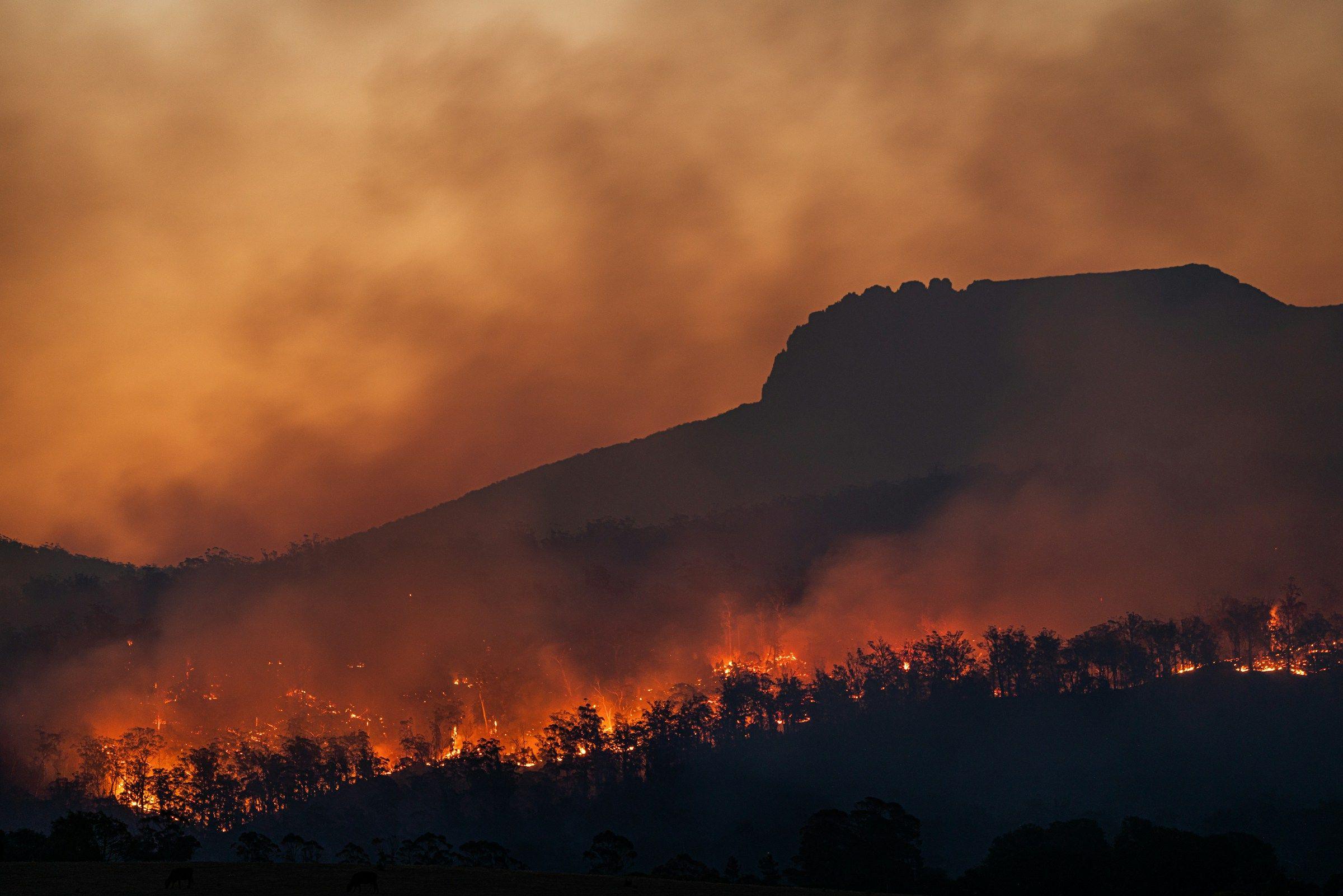
Image: Matt Palmer / Unsplash
News story
25 February 2026
How can Australia build resilience, protect nature, and support community wellbeing in a future with more frequent and severe natural disasters?
Across Australia, devastating bushfires, floods, a marine heatwave and enormous harmful algal bloom are affecting communities, wildlife and ecosystems. While natural disasters have long shaped this country, climate change is increasing their frequency and intensity, creating a more volatile future.
What does it take to prepare for a future shaped by more frequent disasters and a changing climate - and build resilience for people and nature?
In this webinar, experts share practical insights on what the future holds and how Australia can strengthen disaster readiness and response - drawing on lessons from events such as bushfires and marine heatwaves - while also addressing the often-overlooked mental health impacts of these events.
Our webinar speakers and topics:
- Hugh Possingham, Biodiversity Council Director and Professor of Mathematics and Professor of Ecology at The University of Queensland. Topic: Moving species, preventing extinctions.
- Don Driscoll, Professor of Terrestrial Ecology at Deakin University. Topic: Understanding and preparing for more frequent and intense bushfires.
- Gretta Pecl, Professor of Marine Ecology at the Institute for Marine and Antarctic Studies (IMAS), Director of the Centre for Marine Socioecology (CMS) at the University of Tasmania. Topic: Understanding and preparing for marine climate change.
- Toby Freeman, Associate Professor at Stretton Health Equity at the University of Adelaide. Topic: Ecological grief and anxiety. The mental health impacts of the algal bloom, and the need for a community wellbeing approach
- Lis Ashby, Policy and Innovation Lead at the Biodiversity Council. Topic: Playbooks for a more uncertain future.
Q&A from the webinar
What has led to the enormous reduction in kelp forests?
Climate change is pushing the East Australian Current to carry semi-tropical water down into Tasmania. This water is both warmer and more nutrient-poor than the colder temperate waters the kelp is adapted to. As a result, the kelp is stressed by being too warm and it doesn't have enough nutrients to draw on. The semi-tropical waters are also bringing sub-tropical species further down the coast, and many of these are herbivores, so more critters are munching on the kelp, which is now weaker and slower-growing due to the temperature and nutrient changes. 70-100 years ago kelp forests were so prolific and thick that shipping maps showed were they were so ships could avoid them, and now less than 5% remain.
What percentage of fisheries would currently be considered sustainable?
The 2024 Status of Australian Fish Stocks (SAFS) Report is prepared by the Fisheries Research and Development Corporation and brings together available biological, catch and effort information to determine the status of Australia’s key wild catch fish stocks. It covers 155 Australian species across 503 individual stocks. It found that 81% of Australian fisheries stocks are sustainable or recovering. You can look up individual species and stocks here.
Could you briefly walk us through the scale, resources and timelines involved in assisted migration?
While a lot has been written about assisted migration, and there are some amazing projects (e.g., western swamp tortoise) we don't have a full analysis of the scale and cost of a nationwide integrated program. Billions are likely required. Given how limited Australia's captive breeding and release programs are, relative to the sheer number of species in trouble, we have a lot to learn on the way. Some government agencies are on it, others like Queensland are yet to engage. Assisted migrations of plants or animals from the Country of one First People's group to another require all parties to be fully informed, involved and consenting. These conversations will take considerable time so should begin as soon as possible. The western swamp tortoise provides an excellent example of what is involved in doing this properly, including though exploration of potential migrations sites and their ability to support translocated populations. The WA Department of Biodiversity Conservation and Attractions has been leading this work, collaborating closely with research partners at The University of Western Australia and former National Environmental Science Program Threatened Species Recovery Hub. To learn more about this project and supporting research check out this factsheet, video and the PhD thesis by Dr Sophie Arnall at The University of Western Australia.
Recurring droughts in SA are causing lack of nectar and declines in large nectar dependent insects...Should we focus on very green urban environments, as we cannot water the bush?
Improving our green urban environments is a very useful tool to protect pollinators, and other invertebrates. However, it does not provide wide-scale conservation, so needs to be considered in combination with a range of other approaches. Drought and climate change are major threats to a range of invertebrates in the bush, but we can help build up resilience of species and communities to better enable them to survive periods of drought. For example, by reducing pressures from other threats, such as weeds or feral honeybees, or by protecting and connecting patches of habitat, so species are better able to survive within patches and are able to move between patches to more suitable habitat, if needed.
Is altering the environment by planting less flammable trees and vegetation a practical strategy to reduce fuel loads and help protect forests?
Understory composition can make a difference to flammability, because with long time since the last fire you end up with less flammable plant species in the understory and that is what leads to reductions in flammability Where there are local native species that could fill that role, it might be worth trying in an experimental framework (with replicates and controls). Not worth trying it with non-native plants due to invasive species risks. It is also an expensive approach that we could only potentially trial in small strips that we can affoard to plant, rather than a strategy for large forest areas.
Farmers control 60% of land in Australia, so can farmers use biodiversity credits to increase biodiversity?
Governments should invest more in land stewardship programs because farmers manage a large proportion of Australia’s landscapes and are essential to reversing biodiversity decline. Many conservation actions on farms deliver public benefits—such as healthier soils, water quality, habitat, and climate resilience - but incur costs borne by the land manager. Compared to market based credit schemes, paying farmers directly through grants, tenders, or stewardship programs is often more effective because these can be designed specifically to maximise biodiversity outcomes. Credit schemes seldom result in overall gains for the environment because they are frequently established as part of offset schemes, so for example, a credit for capturing carbon here is used to balance the releases of carbon over there. Carbon credit schemes can deliver secondary biodiversity gains (eg through planting trees to sequester carbon) but do so less often that people might expect. This is because carbon schemes designed for market efficiency often prioritise low-cost actions, like monoculture plantings, which deliver limited biodiversity benefits. Research has found that the most efficient places to put carbon projects also seldom line up with biodiversity priorities. Even where credit schemes are designed specifically for biodiversity and are not used to offset loss elsewhere they face major integrity risks because biodiversity is complex and hard to commodify.
Resources
COMMUNITY RESILIENCE TO DISASTERS
Nature-led Community Resilience (NLCR) is about helping communities prepare for and recover from disasters by strengthening their connection with nature. NCLR is founded on the reciprocal relationship between people and nature. NLCR involves people healing nature and nature healing people. The Victorian Government's Arthur Rylah Institute for Environmental Research has developed a NLCR toolkit which provides resources and stories of how others have done it. It was delivered post wildfire recovery, but has been tested and applied in various contexts. You can access or learn more about the tool kit here. (Thank you, Fern H, for the recommendation)
FIRES
Following the catastrophic 2019-20 Black Summer wildfires burnt more than 12 million hectares over the period August 2019 to March 2020, across forests, heathlands and farmlands from south-eastern Queensland to eastern Victoria, on Kangaroo Island and in south-western Australia. The fires were abnormally extensive, long-lasting and severe, catalysed by extensive drought and unusually high temperatures. They left many threatened species in a far more imperilled state, and resulted in once 'safe' species becoming insecure. Following the fires the former National Environmental Science Program Threatened Species Recovery Hub rapidly undertook a wide range of related research to prioritise responses and learn lessons for future catastrophes. You can see the list of projects and access factsheets and reports summarising the findings here.
MARINE SPECIES MIGRATIONS
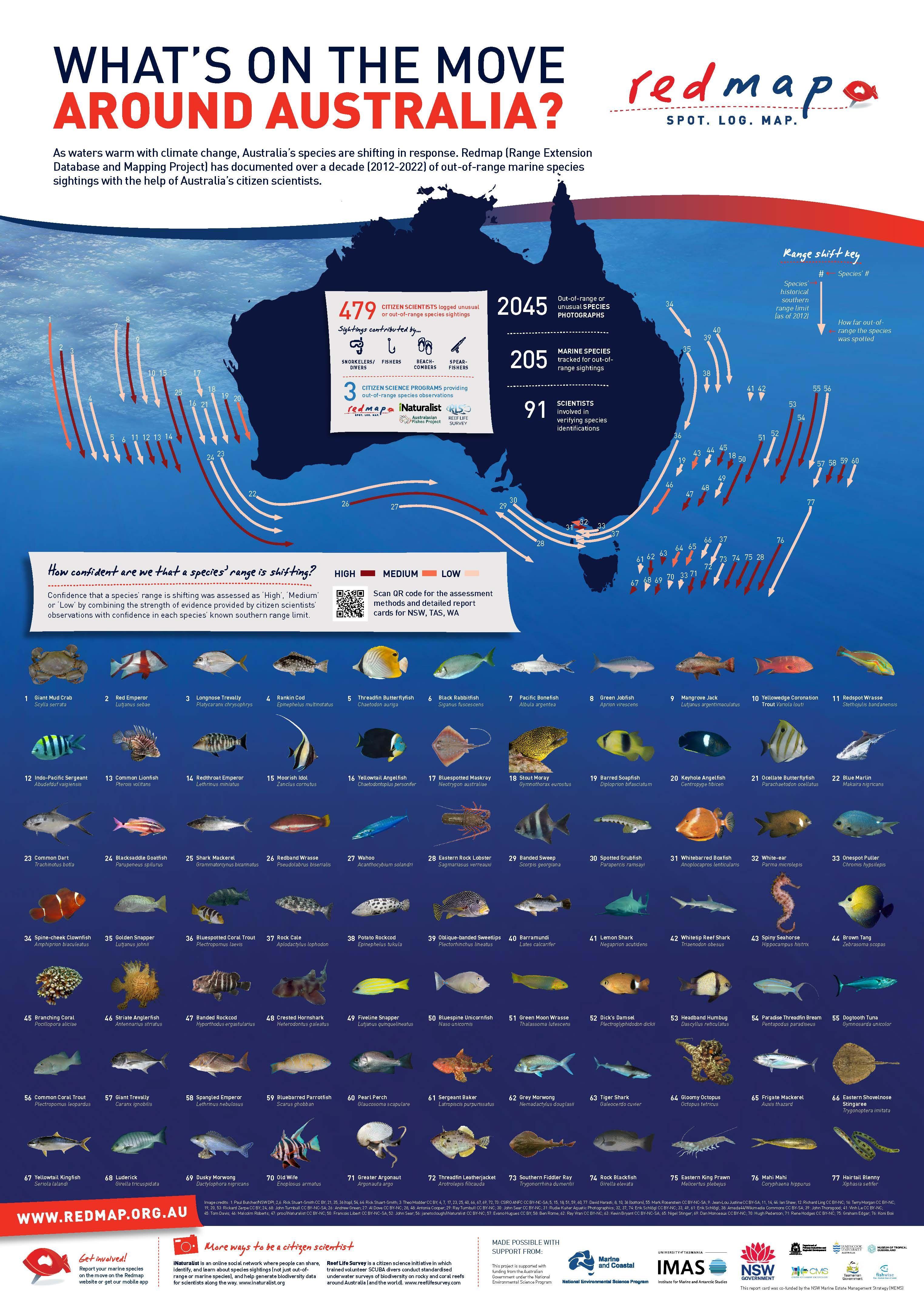
There was strong interest in the mapping of where marine species are moving in response to climate change impacts on oceans. A great resources is Redmap Australia and their Nationa, WA, NSW and Tas report cards.