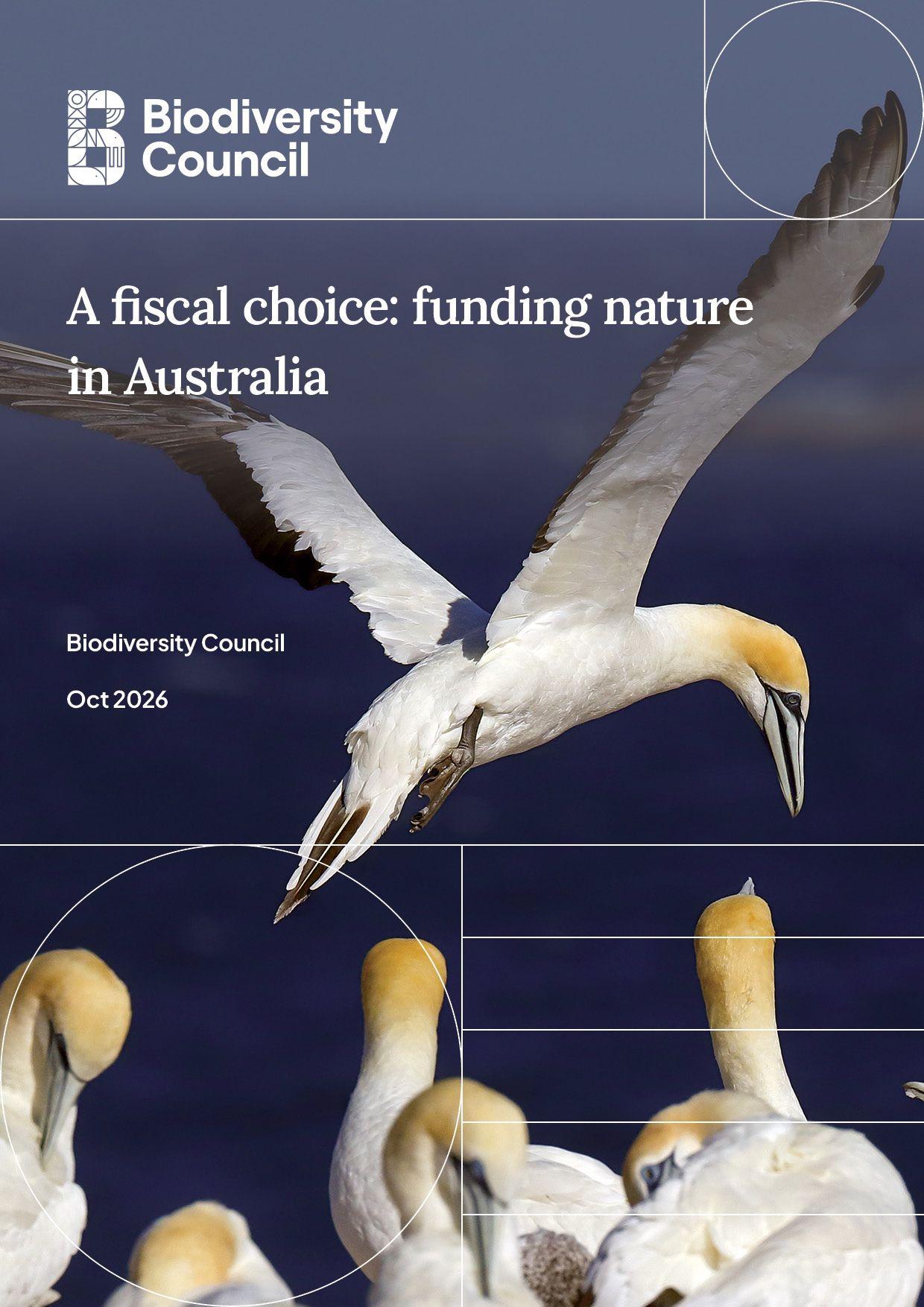
Australasian Gannet colony in Victoria. Image Patrick Kavanagh CC BY 2.0 Flickr
A fiscal choice: funding nature in Australia
Report
28 October 2026
This report outlines research led by the Australian National University, which provides a first estimate of the funding needed for Australian government to meet all commitments under the Global Biodiversity Framework (GBF) of the United Nations Convention on Biological Diversity (UNCBD) and the amount of harmful subsidies that also need to be reformed. It comes as progress toward meeting the GBF targets is under scrutiny at the Conference of the Parties of the UNCBD (COP 17) in Yerevan, Armenia from 19-30 October, 2026.
Key points
- COP 17 will review global progress on the GBF, and the CBD Secretariat reports that finance and harmful subsidy reform are lagging. Australia is exposed on both. It has not identified its harmful subsidies, due by 2025, nor set out to reform or repurpose them by 2030, as Target 18 requires. It has made no material commitment to a major uplift in public funding for biodiversity, as Target 19 requires.
- A first pass estimated that the Australian Government spent at least AU$26.3 billion in 2022–23 on subsidies that harm biodiversity. This equates to more than 25 times what it spends on conserving it.
- New research estimated that delivering all 23 GBF targets would cost Australian governments about AU$29.3 bn/yr, around 1.1 per cent of GDP.
- The two figures are of similar size. Australia’s failure to conserve nature is a fiscal choice, not a question of fiscal capacity.
- The Commonwealth raises the bulk of national taxation revenue and should fund the bulk of the task: about AU$23 bn/yr, against current spending about AU$0.9 bn/yr. It has at least four ways to fund the uplift: repurpose harmful subsidies, reform the taxation of natural resources, direct carbon investment into biodiverse restoration, and/or reprioritise existing spending.
Download the report for the full details.
How to cite the report:
Elton, P., Ashby, L., Ward, M., Iftekhar, M.S., and Clement, S. (2026). A fiscal choice: funding nature in Australia. Report prepared for the Biodiversity Council. October 2026. Biodiversity Council, Melbourne, Australia. https://biodiversitycouncil.org.au/resources/a-fiscal-choice-funding-nature-in-australia